How Texas Flooring Contractors Name Their Businesses
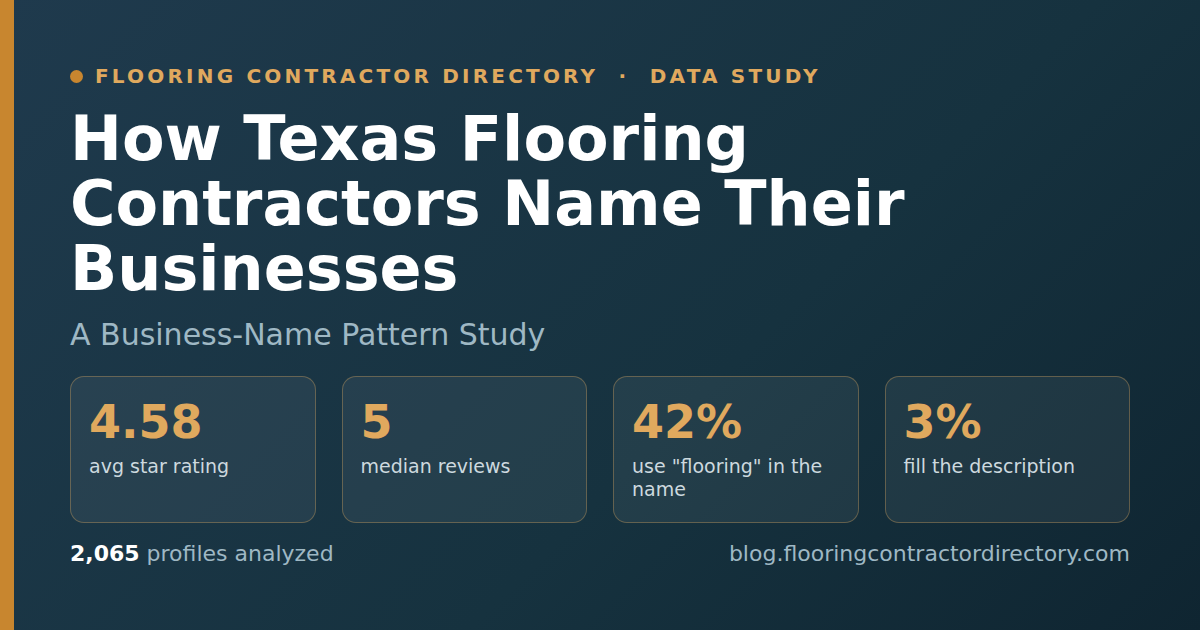
Table of contents
Abstract
This study reads the actual names Texas flooring contractors give their businesses on Google, then asks the question every local search ranking turns on: does the name say what the company does? We parsed the business names of 2,065 Texas flooring profiles in the sample and counted how often each meaningful keyword shows up. The headline finding is a gap, not a trend: most Texas flooring contractors leave their single most important keyword out of their own name.
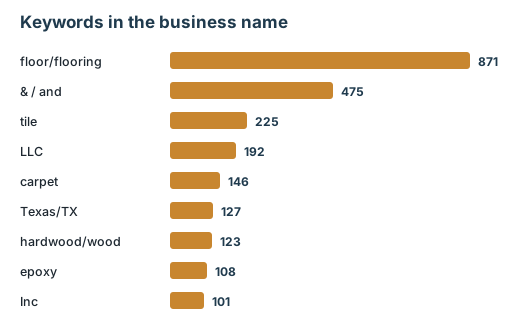
Only 871 of 2,065 names, just 42.2%, contain the word floor or flooring at all. That means the clear majority, 57.8%, omit the core keyword entirely. The next most common element is not a service word but the connector found in partnership names, "&" or "and", at 475 mentions. Material keywords are sparse: tile at 225, carpet at 146, and hardwood or wood at 123, with epoxy at 108, while vinyl and laminate appear in just 2 names each. Geography is nearly absent too, with Texas or TX in only 127 names. Business suffixes are common, LLC at 192 and Inc at 101, but those add no search relevance. The takeaway for contractors and homeowners alike: in a market where the name is one of the strongest local SEO signals a Google Business Profile carries, a wide-open naming gap sits unclaimed by nearly six in ten Texas flooring businesses.
Methodology and Sample
This study reads the names themselves. We took every Texas flooring contractor business name in our dataset and ran a plain, repeatable keyword scan over the name text to see which words contractors reach for when they brand a flooring company. The question is simple: across 2,065 Texas flooring contractors, how often do names lean on trade words like floor, tile, and carpet, on legal tags like LLC and Inc, on a place name like Texas, or on the ampersand that signals a partnership?
Data and method
The population is flooring contractors only. We started from a statewide pull of 2,065 contractors and filtered down to genuine flooring, tile, carpet, and refinishing businesses. General contractors, roofers, carpet-cleaning-only outfits, and pure retail stores were excluded, so the names we measured belong to the flooring trade and not some adjacent line of work.
Against those 2,065 business names we ran a single deterministic, case-insensitive keyword frequency scan. The dictionary was fixed in advance, so no term was added after seeing the results. For each name we checked for the presence of these terms:
- Trade words: floor or flooring, tile, carpet, hardwood or wood, vinyl, and laminate.
- Legal and structure tags: LLC, Inc, and the & or and that marks a partnership name.
- Place words: Texas or TX.
The scan counts presence: how many of the 2,065 names contain a given term at least once. Because a single name can contain several terms at once (for example a name with both flooring and LLC), the counts across categories are not meant to add up to the total. Each number stands on its own as the share of names that use that word.
We keep the counting deterministic on purpose. The tally is mechanical and repeatable, which means the statistics stay honest and nothing is invented to fit a narrative.
Limitations
A name scan is a blunt instrument, and the numbers below are best read as directional rather than as a verdict on any one brand. The honest caveats:
- Presence count, not a quality judgment. This is a keyword presence count on the business-name text only. It measures which words appear, not whether a name is good, memorable, or effective.
- Spelling and abbreviation gaps. Abbreviations and creative spellings may not match the fixed dictionary, so a name that means "flooring" without spelling it out would not register as a hit.
- Name text as scraped. The name text reflects the Google Business Profile name at scrape time, so any later rebrand or edit on the profile is not captured here.
How Contractors Name Their Businesses
A business name is the very first piece of text Google reads about a company, and it is the first thing a homeowner sees in the search results. For a local service category it does double duty: it tells a stranger what you do, and it feeds the single most literal relevance signal an algorithm can latch onto, the words in the name itself. So when we pulled the names of all 2,065 Texas flooring contractors in this study and counted what they actually contain, we were not just cataloguing branding taste. We were measuring how much of the field is making itself easy or hard to find. The short version: most of them are making it harder than it needs to be.
The keyword gap
Across the 2,065 contractors, only 871 (42.2 percent) include the word "floor" or "flooring" anywhere in their business name. Read that the other way around and it is more striking: the majority, 57.8 percent, operate under a name that gives Google and a prospective customer no direct textual signal of what the business actually does. That is not a handful of outliers. That is roughly 1,194 of 2,065 contractors, the larger half of the entire field, whose name alone would never tell you they install floors.
For a category where the exact match keyword still carries weight in local discovery, and where the name is one of the few fields a contractor controls completely and for free, that is a large and self inflicted gap. A name like "Lone Star Floors" or "Johnson Custom Floors" is working for the business in every result it appears in. A name built on a surname or an abstract brand is leaving that work on the table, and counting on category fields, reviews, and the description to make up the difference, fields that, as the rest of this study shows, most contractors are not filling out either.
Materials and modifiers
If most names skip the generic keyword, do they at least name the specific material they specialize in? Mostly not. Material words are surprisingly thin on the ground, and the way they are distributed says a lot about which trades think of themselves as a distinct specialty and which simply call themselves "flooring."
- Tile is the most common material word, appearing in 225 names (10.9 percent). Tile contractors are clearly the group most willing to name their niche outright.
- Carpet appears in 146 names (7.1 percent), a meaningful but smaller share, even though carpet remains one of the most installed products in the state.
- Hardwood or wood shows up in 123 names (6.0 percent), putting wood specialists in roughly the same band as carpet.
- Vinyl and laminate are the great absentees, with just 2 names each (0.1 percent). This is the most counterintuitive finding in the entire naming dataset: vinyl and laminate are among the most heavily installed flooring products in Texas homes today, yet virtually no contractor builds the name around them.
The vinyl and laminate blind spot is worth sitting with. Demand for these products is everywhere, the search terms are real, and the competition for the name is effectively zero. A contractor who specializes in luxury vinyl plank and says so in the business name would stand almost alone in a field of 2,065. That is not a crowded street to compete on; it is an empty one.
Partnership and entity framing
When the field is not naming what it installs, what is it putting in the name instead? Overwhelmingly, relationships and legal structure. The single most common structural element in the entire dataset is not a material at all.
- Partnership or family framing dominates: 475 names (23.0 percent) contain an "&" or the word "and." Nearly one in four Texas flooring businesses signals a partnership, a family, or a pairing right in the name. That is more than double the share that names tile and well over five times the share that names carpet.
- LLC appears in 192 names (9.3 percent), the most common entity marker.
- Inc trails at 101 names (4.9 percent), roughly half as common as LLC.
- Geographic anchoring is surprisingly light: only 127 names (6.1 percent) carry "Texas" or "TX," despite location being one of the strongest relevance signals in local search.
Step back and the priorities of the field come into focus. A Texas flooring contractor is more likely to tell you they are a partnership (23.0 percent) than to tell you they install floors (well, 42.2 percent do say floors, but partnership framing beats every single material word). They are more likely to put "LLC" in the name (9.3 percent) than to put "Texas" in it (6.1 percent). The instinct across the field is to signal who we are and how we are organized, while leaving what we do and where we do it for the search engine to infer.
The SEO opportunity
Put all of this together and the naming data points to one of the clearest, cheapest competitive openings in the whole study. The business name is a field every contractor controls completely, costs nothing to optimize, and carries real weight in local discovery. Yet 57.8 percent of the field omits the core keyword, 89 percent or more omit every individual material word, and a striking 93.9 percent leave out any Texas or TX reference. The crowd is competing on partnerships and entity suffixes; almost no one is competing on the words a homeowner would actually type.
The implication is not that every contractor should rush to rename the business, and it is certainly not that "& Sons" should be stripped out of a name customers already know and trust. It is that the name is a signal, and most of the field is using it to say things that do not help a stranger find them. Where it fits, a name that carries the service, the standout material, and ideally the city does discovery work in every result it appears in, and it does so in a field where the larger half of competitors have left that lane wide open. For a specialist in vinyl or laminate in particular, the lane is not just open; it is empty.
Conclusions: A Blueprint to Adapt
A business name is not a ranking factor you can game, it is a signal. Across 2,065 Texas flooring contractors, the same pattern repeats: most names tell you who runs the company, but far fewer tell you what the company actually does. Only 871 of the 2,065 names, 42.2 percent, include the word "floor" or "flooring," which means 57.8 percent leave the core service out of the name entirely. What follows is not a rigid checklist to copy line by line, and it is certainly not a push to rebrand. It is a blueprint of principles to weigh against your own business and your own market, framed by the questions worth asking before you ever touch a sign or a logo.
A blueprint for contractors
Read the naming data as a map of where the opportunity sits, not as a verdict on any one name. The single biggest pattern is a missing keyword, and a missing keyword is a discovery signal you have chosen not to send. The point is not that every contractor should be named "Something Flooring." The point is to understand what your name does and does not do for a stranger who has never heard of you.
Put the service in the name where it fits
With 57.8 percent of names omitting "floor" or "flooring," the most common pattern in Texas is a name built around a person or a place rather than the work. That is not wrong. Plenty of those companies are excellent, and a strong reputation can carry a generic name a long way. But when a homeowner types "flooring" into Google Maps, a name that contains the word they typed has one quiet advantage in plain readability, and the 871 contractors who already include it are sending that signal without thinking about it.
This is guidance, not a mandate. Renaming an established business with years of reviews and word of mouth attached to it can cost you more than the keyword is worth. The useful move is to know which side of the line you are on, and to make the choice on purpose.
Questions to ask yourself
- Is your name doing any work for a stranger? A loyal customer searching your name finds you no matter what it says. A new customer searching "flooring" is the one who benefits when the service is in the name. Which customer are you optimizing for?
- If you are starting fresh, the cost of adding the keyword is almost zero. With nearly six in ten Texas contractors leaving it out, a new business has an easy way to read clearly to both people and search.
- If you are already established, the name on the building matters far less than your category, your description, and your reviews. Do not rebrand for a keyword. Put that energy where it pays off.
How to use this
Treat each point as a direction to adapt, not a fixed rule. Start where the gap between your profile and the data above is widest.
Consider material and city signals
Beyond the core keyword, the data shows the more specific signals are sparse, which means they are also uncrowded. Material words barely register: "tile" appears in 225 names, "carpet" in 146, and "hardwood" or "wood" in 123. Geographic words are rarer still, with only 127 of the 2,065 names, just over six percent, containing "Texas" or "TX."
Sparse is not the same as wrong, and stuffing your name with materials and cities is its own mistake. But if your business genuinely specializes, a material word can do honest work. A name with "tile" in it tells a tile shopper they are in the right place before they read a single review, and only 225 names currently claim that signal. The same logic applies to carpet and hardwood.
Questions to ask yourself
- Do you actually specialize? A material word only helps if it is true. If you install everything, a broad name serves you better than a narrow one that scares off half your jobs.
- Is a city signal honest for you? With "Texas" or "TX" in only 127 names, a location word is uncommon, but it is most useful for a single-market business, not one that travels the state. Match the name to the territory you really serve.
A blueprint for homeowners
A name is the first thing you see and the least reliable thing you can judge a contractor on. Read past it.
- A generic name does not mean a bad contractor. Nearly six in ten Texas flooring companies do not put "floor" or "flooring" in their name, and many of them do outstanding work. A name built around a family or a hometown is a stylistic choice, not a warning.
- A keyword in the name does not mean a good one. The word "flooring" on the sign tells you nothing about whether they show up on time or clean up after themselves. It is marketing, not a guarantee.
- Judge on the reviews, not the business name. The pattern across hundreds of reviews, what real customers say about reliability, quality, and communication, will tell you far more than any word a contractor chose to put on the truck.
Put this report to work
For homeowners: see these patterns in real listings. Browse the directory's Texas flooring contractors to compare reviews and ratings for yourself, and read how the directory works before you reach out.
For contractors: the patterns above are your opening. List your business in the directory, and if you need a stronger online presence, get a flooring website so customers can find you.
Frequently Asked Questions
Do most Texas flooring contractors put "flooring" in their business name?
Yes, more than any other word. Out of 2,065 Texas flooring contractors in this study, 871 use the word floor or flooring in their business name, which works out to 42.2 percent. That makes it by far the most common naming choice, but it also means the majority of Texas flooring businesses, roughly 1,194 of them, do not lead with the word at all. Putting flooring in the name is the popular default, not a universal rule.
What share of Texas flooring businesses include the word "floor" or "flooring"?
Exactly 42.2 percent, or 871 of the 2,065 contractors we analyzed. It is the single most frequent keyword in the dataset by a wide margin. The next closest material word, tile, appears in only 225 names, so flooring shows up almost four times as often as the runner up. If you are choosing a name and want to match what most of your competitors do, flooring is the word they reach for.
Do material keywords like tile or hardwood appear often in the names?
Some do, most do not. After the generic floor and flooring at 871 names, the most common material word is tile at 225 names, followed by carpet at 146 and hardwood or wood at 123. The big surprise is how rare the trendy materials are: vinyl appears in just 2 names and laminate in just 2 names across the entire sample of 2,065 businesses. So contractors who install LVP or laminate almost never say so in the name, even though those products are everywhere in their reviews and service lists.
Should a flooring contractor put the city or "Texas" in the business name?
It is a minority move. Only 127 of the 2,065 contractors, about 6.2 percent, include Texas or TX in the business name. The other roughly 94 percent rely on Google to handle their location through the Business Profile address and service area instead of baking it into the name. Geography can help a stranger understand who you are at a glance, but the data shows the overwhelming majority of Texas flooring contractors do not depend on a place word in the name to compete.
How many Texas flooring contractors put "LLC" in the name?
192 of the 2,065 contractors, just over 9 percent, carry LLC in the business name shown on Google. That is more common than the location words but still a small slice. The legal suffix signals a registered entity, yet the data is clear that the vast majority of Texas flooring businesses, more than 90 percent, leave LLC off the name people actually see in the map pack.
Does the business name affect Google rankings?
The name is one input, not a magic lever, and this study measures naming, not ranking position, so treat this as context rather than a promise. What the data does show is that a keyword name is common but not dominant: only 42.2 percent of contractors use floor or flooring, which means plenty of successful Texas flooring profiles rank and earn reviews without a keyword in the name. Google reads your category, services, and reviews too. An exact match name can help a searcher and an algorithm understand you quickly, but the majority of the field competes without one.
Is a keyword-free business name a red flag for a flooring contractor?
No. Since fewer than half of Texas flooring contractors, 42.2 percent, even use floor or flooring in the name, a keyword-free name is the norm for the other 57.8 percent, not a warning sign. Many of those businesses use a family name, a brand word, or a partnership style name. What matters far more for a homeowner is the Google category, the service list, the photos, and the review history, none of which depend on whether the word flooring sits in the title.
Related Reports
Keep exploring the Texas flooring data network: