Ratings and Review Volume Across Texas Flooring Contractors
Table of contents
Abstract
This study asks whether a Google star rating actually separates Texas flooring contractors, or whether the real differentiator is something else entirely: review volume. Across the 2,065 profiles in the sample, the 1,735 contractors that carry a rating average 4.58 stars, and that average barely moves the needle because almost everyone clusters near the ceiling. 732 sit at a perfect 5.0 and another 587 fall in the 4.5 to 4.9 band, so roughly four in five rated contractors live above 4.5. Only 204 land in 4.0 to 4.4, 158 in 3.0 to 3.9, and a mere 54 below 3.0. When nearly everyone scores an A, the grade stops telling homeowners anything.
The signal that does separate contractors is how many reviews back that rating, and here the distribution is violently skewed. The median contractor has just 5 reviews, yet the mean is 42.1, a gap that only happens when a small group of heavily reviewed profiles drags the average far above the typical business. The bands make the skew plain: 836 contractors have zero reviews at all, another 346 sit at 1 to 9, 492 at 10 to 49, 312 at 50 to 199, and just 79 have crossed 200 or more. The takeaway for contractors and homeowners alike: a high star rating is table stakes that almost everyone clears, but review volume is the scarce, hard to fake signal that actually ranks one Texas flooring contractor above the next.
Methodology and Sample
This study measures the two reputation signals a Texas flooring shopper sees first on a Google Business Profile: the star rating and the review count. We pulled both numbers for flooring contractors across Texas, then looked at how ratings cluster, how lopsided review volume really is, and how many profiles have nothing to show at all. The aim is to describe, in plain numbers, what an average and an above-average flooring reputation looks like in this market.
Data and method
The population is flooring contractors only. We started from a statewide pull of 2,065 contractors and filtered to genuine flooring, tile, carpet, and refinishing businesses. General contractors, roofers, carpet-cleaning-only outfits, and pure retail stores were excluded so the figures reflect the flooring trade and not some adjacent line of work.
For each of those 2,065 contractors we recorded the profile-level Google star rating and the visible review count. A star rating was present on 1,735 profiles, the businesses that have collected enough feedback for Google to display an average. Review counts were read for every profile in the set, and 1,229 contractors carry at least one visible review. The remaining profiles are live but silent, which is itself a finding we return to later.
The method is deliberately simple and deterministic. We took the rating and count as Google presents them, then grouped contractors into bands so the shape of the market is visible rather than hidden inside a single average. Nothing is modeled, weighted, or inferred. Every number in this study is a direct count from the data, and no business was selected after the fact to fit a story.
Limitations
A reputation study is only as honest as the caveats it owns up front. Read every figure below with these constraints in mind:
- Profile-level ratings, not per-review stars. Individual review star scores were not available, so all rating figures are the profile-level average Google shows. We cannot break a contractor's average down into its underlying one to five star reviews.
- Visible review counts. Each count reflects the number of reviews Google publicly displays on the profile, which is not necessarily every review the business has ever received.
- Filtered flooring-only population. The figures describe the filtered set of 2,065 genuine flooring contractors, not every business that might appear under a broad flooring search. Findings apply to this population and should not be read as the entire Texas home-services market.
Ratings and Review Volume
Reputation is the single line most homeowners read before they ever click a flooring contractor's name in Google. It comes in two parts: the star rating and the review count sitting next to it. They look like the same signal, but across 2,065 Texas flooring contractor profiles they behave nothing alike. One is so compressed it tells you almost nothing. The other spreads across two full orders of magnitude and quietly decides who gets the call. This section pulls the two apart and shows why the number most contractors obsess over is the one that matters least.
Ratings cluster near the ceiling
Of the 1,735 profiles that carry a star rating at all, the average sits at 4.58. On its own that number reads like a meaningful score. It is not. The moment you break it into bands, the distribution turns out to be jammed against the top of the scale, with almost no spread left to separate one contractor from the next.
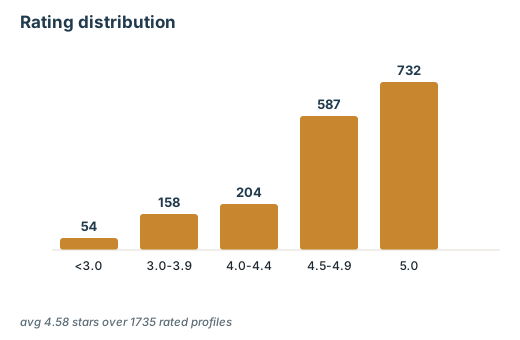
Look at how lopsided the bands are. A full 732 profiles, the largest group of all, hold a perfect 5.0, and another 587 land in the 4.5 to 4.9 range. Stack those together and 1,319 of the 1,735 rated profiles, just over three out of every four, sit at 4.5 stars or higher. The lower bands are nearly empty by comparison:
- 5.0 stars: 732 profiles, the single biggest band.
- 4.5 to 4.9 stars: 587 profiles.
- 4.0 to 4.4 stars: 204 profiles.
- 3.0 to 3.9 stars: 158 profiles.
- Below 3.0 stars: only 54 profiles.
The bottom of the scale barely exists. Only 54 profiles fall below 3.0, which means a homeowner scanning Texas flooring contractors will see a wall of 4.5-and-up ratings with the occasional outlier. When a perfect 5.0 is the most common outcome on the entire scale, the star rating stops working as a comparison tool. Everyone looks excellent, so excellent stops meaning anything.
There is a quieter reason the ceiling stays so crowded, and it shows up later in the review language itself: praise words like recommend, great, and professional dominate the verbatim reviews by enormous margins. The people who bother to leave a review are mostly happy. That self-selection pushes nearly every profile that has any reviews at all toward the top of the scale, which is exactly why the rating compresses the way it does.
The takeaway
The 4.58 average is statistical noise for the purpose of choosing a contractor. With three in four profiles at 4.5 or better and a perfect 5.0 as the most common single result, a high star rating is the price of entry, not a differentiator. It tells you a contractor is not actively disliked. It does not tell you they are trusted, established, or busy. For that you have to look at the number next to the stars.
Review volume is the real signal
Review count is where the real separation lives, and it is dramatic. The median Texas flooring contractor has just 5 reviews. The average is 42.1. When the mean is more than eight times the median, you are not looking at a normal spread, you are looking at a heavy right skew: a small number of high-volume profiles dragging the average far above where the typical contractor actually sits.
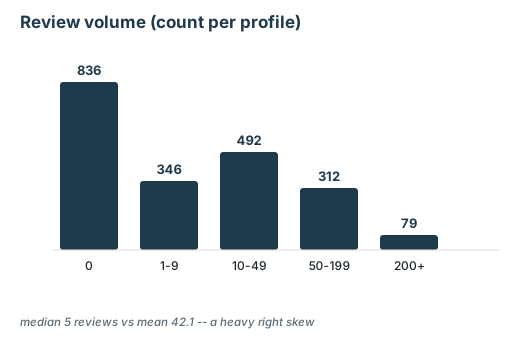
The bands explain the gap between the median and the mean better than either number can alone:
- 0 reviews: 836 profiles, the largest group on the chart.
- 1 to 9 reviews: 346 profiles.
- 10 to 49 reviews: 492 profiles.
- 50 to 199 reviews: 312 profiles.
- 200 or more reviews: only 79 profiles.
Start with the bottom. 836 of the 2,065 profiles, more than four in ten, have zero reviews. Add the 346 with one to nine, and 1,182 contractors, well over half the entire field, sit at fewer than ten reviews. That is what drives the median down to 5. For a homeowner, a profile in this range carries almost no social proof. It is a name and a star rating built on a handful of opinions, easy to scroll past in favor of the contractor right below it with a few hundred.
Now the top. Only 79 profiles, fewer than four percent of the field, have reached 200 reviews or more. This tiny group is doing almost all the heavy lifting on the average. A single 800-review profile offsets a hundred profiles with zero, which is precisely how a median of 5 and a mean of 42.1 can describe the same population. The 50-to-199 band adds another 312 genuinely established profiles, but together with the 200-plus group they are still the visible minority. The middle 10-to-49 band holds 492 contractors, the realistic on-ramp where a profile starts to look credible without yet being dominant.
Why volume beats the average
Star ratings compress; review counts expand. That is the whole story. Because nearly every rated profile lands at 4.5 or above, the rating cannot tell two contractors apart. Review volume can, and does, across a range that runs from zero to the hundreds. It is the clearest evidence on the entire profile that a business has actually done the work, served real customers, and is still operating at scale.
The gap is also where the opportunity sits. With 836 profiles at zero and a median of just 5, the bar to climb out of the invisible majority is astonishingly low. A contractor does not need to chase the 79 profiles in the 200-plus band to win the comparison on a search results page. Moving from zero to a steady, modest stream of reviews lifts a profile past more than half the field, because more than half the field is stuck below ten. The star average will take care of itself, as the data shows it nearly always does. The number worth building is the one beside it.
Conclusions: A Blueprint to Adapt
The ratings and review numbers in this study are not a leaderboard, they are a map. The average Texas flooring contractor sits at a high 4.58 stars, which means the star rating alone barely separates one business from another. The real story is volume, and it is wildly uneven: the typical profile carries a median of just 5 reviews while the average is 42.1, a gap that exists only because a small group of profiles has stockpiled hundreds of reviews and dragged the mean upward. What follows is not a rigid checklist to copy line by line. It is a blueprint of principles to adapt to your own business and your own market, framed by the questions worth asking before your next job.
A blueprint for contractors
Stop competing on the star average, because almost everyone is already near the top of it. The lever you actually control is how many reviews you have and how steadily they arrive. The data points to one conclusion again and again: a contractor who simply asks, every time, will pull away from the crowd that never does.
Chase volume, not the star average
With the state average rating at 4.58, your stars are not the problem and they are not the differentiator. The number that moves you is review count, and the bar is far lower than most contractors assume. A full 836 profiles in this study sit at zero reviews, so even a steady trickle of feedback vaults you past hundreds of competitors who have none. The median profile has only 5 reviews, which means a handful of honest reviews is enough to land you above the typical Texas flooring business. You do not need to chase the 200-plus club, which is just 79 profiles statewide. You need to leave the bottom.
Questions to ask yourself
- The zero trap: are you one of the 836 profiles with no reviews at all? If so, your first review is the single highest-value piece of marketing you can earn this month, and it costs nothing but the ask.
- The median gap: the typical profile has 5 reviews. How far above that line are you, and how many completed jobs in the last year never turned into a review because nobody asked?
- The mean illusion: the average of 42.1 looks intimidating, but it is inflated by the rare 200-plus outliers. Measure yourself against the realistic median of 5, not the lopsided mean.
The point is freeing, not daunting: the competition for reviews in Texas flooring is soft. The vast middle has barely started, so consistent effort is rewarded fast.
How to use this
Treat each point as a direction to adapt, not a fixed rule. Start where the gap between your profile and the data above is widest.
Make review requests a routine
The gap between a median of 5 and an average of 42.1 is not luck or talent. It is cadence. The profiles in the upper bands did not earn hundreds of reviews from one big push; they earned them by asking on every job, for years. A one-time blast gets you a brief bump and then silence. A standing habit compounds.
Building the habit
- Ask at the moment of delight, when the floor is finished and the customer is happiest, not weeks later when the memory has faded.
- Make it the last step of the job, the same way you sweep up before you leave. A review request that is part of your closing routine never gets forgotten.
- Aim for steady, not spiky. A few new reviews every month keeps your profile looking active and current, which matters more than a stale wall of old five-stars.
- Treat recency as part of the work. Fresh reviews signal a business that is still busy and still cares, and that is exactly what a nervous homeowner is scanning for.
The takeaway is simple: volume beats average, and cadence beats a one-time push. The stars are already there. Build the routine that turns finished jobs into the review count that separates you from the 836 profiles stuck at zero.
A blueprint for homeowners
A single star number tells you almost nothing here, because nearly every Texas flooring contractor hovers around 4.58. Read for depth instead.
- Weigh review volume and recency over a lone star rating. A 5.0 built on two reviews is far weaker evidence than a 4.7 built on dozens. With the average rating sitting at 4.58 across the board, the star number is the least useful thing on the page.
- Be wary of profiles with very few reviews. The median Texas flooring profile has just 5 reviews, and 836 profiles have none at all. A near-empty profile is not proof of bad work, but it is proof you have almost nothing to go on.
- Favor a recent, steady stream. A contractor still collecting reviews this month is demonstrably still working and still accountable. A wall of reviews that all stopped two years ago is a question mark.
Put this report to work
For homeowners: see these patterns in real listings. Browse the directory's Texas flooring contractors to compare reviews and ratings for yourself, and read how the directory works before you reach out.
For contractors: the patterns above are your opening. List your business in the directory, and if you need a stronger online presence, get a flooring website so customers can find you.
Frequently Asked Questions
What is the average Google rating for Texas flooring contractors?
Across the 1,735 Texas flooring contractors that carried a star rating, the average came out to 4.58 stars. That number sounds impressive until you see how the ratings cluster: 732 profiles sit at a flawless 5.0, and only 54 fall below 3.0. When the typical contractor is already near the ceiling, a high rating tells you very little about who is actually better. The average is compressed, not earned through fierce competition.
Why does the star rating barely matter for Texas flooring contractors?
Because almost everyone has a good one. With an average of 4.58 stars and 732 profiles parked at a perfect 5.0, the rating field is too crowded at the top to separate a great contractor from an average one. Only 54 profiles score under 3.0, so a low rating is genuinely rare and worth noticing, but a high one is the default. The number that actually does the work of distinguishing contractors is review volume, not the star average.
How many reviews does a typical Texas flooring contractor have?
The median Texas flooring contractor has just 5 reviews. The average is far higher at 42.1, but that gap is the tell: a small number of heavily reviewed profiles drag the mean up while most contractors sit near the bottom. Whenever the mean is roughly eight times the median, you are looking at a long tail, not a typical experience. For most Texas flooring profiles, a handful of reviews is the norm.
How many Texas flooring contractors have zero reviews?
836 contractors in the sample have no reviews at all. Out of 2,065 contractors studied, only 1,229 had collected even a single review, which means roughly four in ten profiles are sitting completely empty. An empty profile is not just a missing star count, it is a missing reason to call. Getting from zero to even a few reviews is the single biggest visibility jump most of these businesses could make.
What review count signals an established Texas flooring contractor?
Volume, not perfection. Only 79 of the 2,065 contractors studied have crossed 200 or more reviews, which puts them in roughly the top four percent of the field. Against a median of just 5 reviews, any contractor with dozens of reviews is already well ahead of the pack, and one with a few hundred is in rare company. A deep review history is far harder to fake than a clean star average, which is exactly why it signals a real, established operation.
Should I trust a 5.0 rating on a Texas flooring contractor?
Only after you check how many reviews are behind it. 732 profiles in this study show a perfect 5.0, but with a median of just 5 reviews, a flawless rating is often built on a tiny sample that a few friends or early customers could produce. A 5.0 from five reviews and a 4.7 from two hundred are not the same signal, and the second is usually the stronger one. Read the rating and the volume together, and weight the volume more.
Is a high rating with few reviews better than a slightly lower rating with many?
Usually no. With an overall average of 4.58 stars and 732 contractors already at a perfect 5.0, near perfect ratings are common and cheap to display. What is genuinely scarce is volume: the median is 5 reviews and only 79 contractors have reached 200 or more. A contractor with many reviews has survived far more chances to disappoint, so a slightly lower rating backed by real volume is typically the safer bet than a spotless rating backed by almost nothing.
Related Reports
Keep exploring the Texas flooring data network: