What Texas Flooring Customers Complain About (and Praise): A Review Study
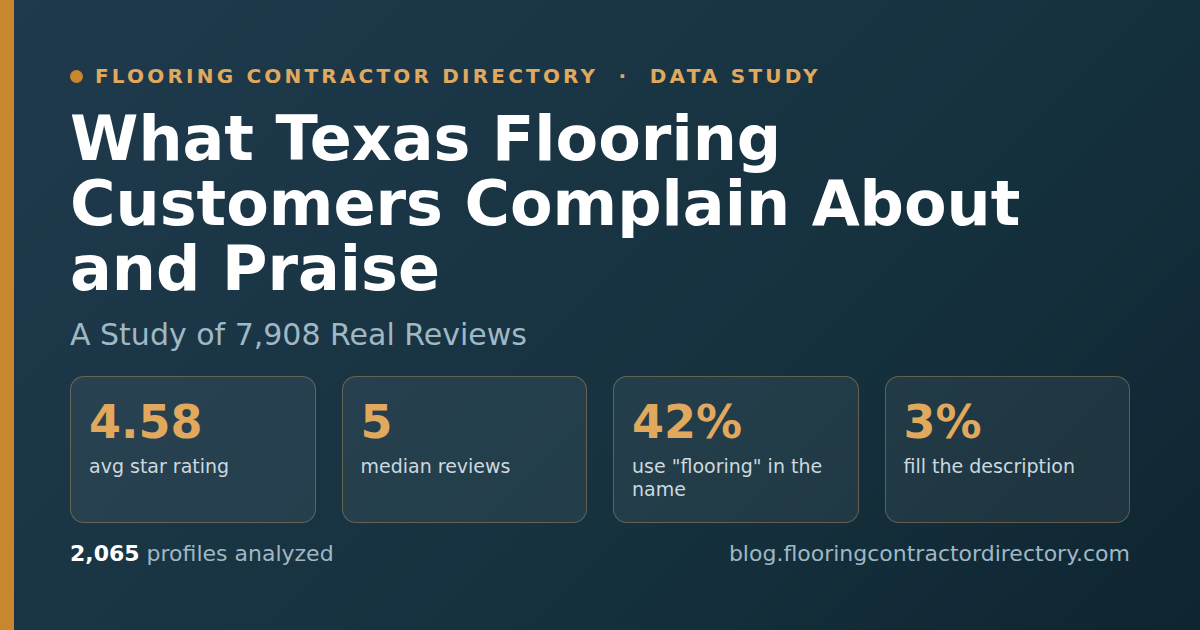
Table of contents
Abstract
This study reads the actual language Texas homeowners use when they review flooring contractors on Google, separating what customers complain about from what they praise. We scanned 7,908 visible reviews across the 1,229 Texas flooring contractors that have reviews (out of 2,065 profiles in the sample) and counted how often specific complaint and praise words appear. The headline finding is one of scale and concentration: praise dwarfs complaint, and the complaint that does exist clusters tightly around a few predictable failures.
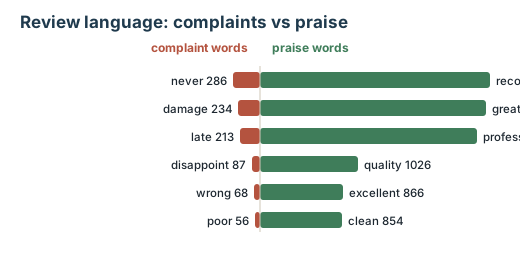
On the negative side, grievances concentrate on reliability and handling: "never" and no-show language leads at 286 mentions, followed by damage at 234 and being late at 213, with everything else (disappoint, wrong, poor) trailing far behind. Praise is both larger and broader, led by recommend at 2,385, great at 2,345, and professional at 2,254, with quality, excellent, and clean rounding out the top tier. The takeaway for contractors and homeowners alike: reputations in Texas flooring are won on professionalism and lost on showing up late, doing damage, or not showing up at all.
Methodology and Sample
This study reads what Texas flooring customers actually wrote. We pulled the publicly visible Google review text from flooring contractor Google Business Profiles across Texas, then measured how often a fixed list of complaint words and praise words showed up across 7,908 reviews. The goal is simple: find out, in customers' own words, what earns a five star reputation in this trade and what tanks one.
Data and method
The population is flooring contractors only. Starting from a statewide pull of 2,065 contractors, we filtered to genuine flooring, tile, carpet, and refinishing businesses. General contractors, roofers, carpet-cleaning-only outfits, and pure retail stores were excluded so the language we measured reflects the flooring buying experience and not some adjacent trade.
Of those 2,065 contractors, only 1,229 carry any visible reviews at all. The remaining profiles are live but silent, which is itself a finding we return to later. Across the profiles that do have reviews, we scanned 7,908 individual review texts.
The method has two layers, and we keep them separate on purpose:
- Word frequency tally. We counted occurrences of a fixed dictionary of complaint terms (words like never, damage, late, unprofessional) and praise terms (words like recommend, professional, quality, clean) across all 7,908 reviews. The list was set in advance so no theme was cherry-picked after seeing the data.
- Verbatim quotes. To illustrate each theme we pulled actual review sentences, word for word, straight from the profiles. Every quote in this study is a real customer's text, not a paraphrase or a composite.
Keeping the counting (the deterministic numbers) apart from the quoting (the human color) means the statistics stay honest and the examples stay real. Nothing here is invented to fit a narrative.
Limitations
Reviews are messy, and a study is only as trustworthy as the caveats it owns up front. Read every number below as directional, not as a precision sentiment score:
- Visible sample, not the full history. We measured the reviews each profile actually shows publicly, which is not necessarily every review the business has ever received.
- Relative dates only. Review timestamps came through as relative phrases like "4 months ago," so we cannot pin reviews to exact calendar dates or build a precise timeline.
- No per-review star ratings. Individual review star scores were not available, so we cannot tie a specific word to a specific 1 to 5 rating. Word counts stand in for sentiment, which is why we call them directional.
- Off-topic noise. Review text includes tangents, owner replies, and unrelated remarks, so the word frequencies are approximate rather than exact sentiment measurements.
- Coverage gap. Only 1,229 of the 2,065 contractors have any reviews at all, so the themes describe the businesses customers chose to talk about, not the silent majority of profiles.
What the Reviews Reveal
We scanned the visible review text across 7,908 reviews on Texas flooring contractor Google Business Profiles, then counted how often customers reached for specific complaint and praise words. The single clearest finding is one of proportion: praise vocabulary does not just edge out complaint vocabulary, it buries it. The word recommend alone shows up 2,385 times, more than eight times the most common complaint word, never, which appears 286 times. Stack the entire praise column against the entire complaint column and the gap only widens. That tells you something important about this trade in Texas: most flooring jobs end with a happy homeowner, and the reviews that do go wrong tend to fail on the same small set of predictable, avoidable things.
What customers complain about
The complaint vocabulary is small but remarkably consistent. Read the top of the list and a single theme jumps out before anything to do with the floor itself: reliability. The three most frequent complaint words are never (286), damage (234), and late (213). Notice what is not at the top: words about the actual flooring product. Customers in Texas are far more likely to write a one-star review because a contractor failed to show up, broke something, or ran behind than because they disliked the tile. The work, when it happens, is usually fine. The process around it is where contractors lose the room.
No-shows and abandoned jobs
The word never tops the complaint list at 286 mentions, and in context it is rarely neutral. It is the word people use for the appointment that never happened, the callback that never came, and the contractor who never finished. The pattern runs from a missed estimate all the way to a fully abandoned project. One reviewer documented being stood up before work even began:
I scheduled two quote appointments with Rakesh from handyman connection and they no showed to both.
Further down the same scale sit the worst cases, where money changed hands and the job simply stopped. The complaint word unfinished is rare (9 mentions), but when it appears the stories are severe:
Filed a complaint with BBB and still didn’t get them to finish the job. Started in April 2019. It is almost Christmas and they just vanished without finishing the job. Sub contractors show up at the door because they never got paid.
That review uses never the way the data predicts it will: not about the floor, but about a promise that was not kept. The same abandonment pattern shows up in shorter form elsewhere, where an installer simply stopped appearing: "4th visit installer never showed up. Complained to the Field MGR. Nothing was resolved" The lesson for contractors is blunt. Showing up, every scheduled day, is the lowest bar in this industry and it is the one most negative reviews accuse them of failing.
Damage to the home
The second most common complaint word is damage at 234 mentions. Flooring work is invasive by nature, demo, hauling, heavy materials moving through finished rooms, so the risk of harming the surrounding home is built into the job. What the reviews show is that homeowners treat protecting the rest of the house as part of the contract, whether or not it was written down. Tellingly, the word damage also appears constantly in positive reviews, precisely because the crew avoided it, which is the clearest possible signal that customers are watching for it. One reviewer praised a repair specifically because no damage was done where they feared it:
We were worried we’d have to tear into the wall to fix it, but he was able to resolve the issue without any damage.
The flip side is the homeowner who feels left with a worse problem than they started with. The complaint word poor (56 mentions) and wrong (68) cluster around exactly this: a finished product that introduced new flaws. One reviewer described paying premium prices for a floor that was, by their account, left defective:
after multiple attempts the flooring is still not right (uneven, shifting, gaps etc). It is just hard to accept that you spend $20K in flooring and you have to look at places in the floor that still are not right.
Lateness and delays
Late rounds out the top three at 213 mentions, and it is the connective tissue between the other two complaints. A late crew becomes a no-show in the customer's mind by mid-afternoon, and a rushed, behind-schedule crew is the one most likely to cause damage. The reviews describe delay as a slow erosion of trust rather than a single dramatic failure: a one-day job that stretches into weeks, an install date that keeps moving, a project that drags past every promised milestone. One countertop customer captured the whole arc in two lines:
worst countertop project ever took over a month to complete the install. Issues to many to say,
The supporting vocabulary tells the same story of frustration compounding over time: disappoint (87), terrible (47), horrible (44), unprofessional (37), and worst (32). At the far tail sit the words that signal a customer who feels actively wronged rather than merely let down: scam (13), refund (13), and avoid (14). These are rare, but they are also the most damaging reviews a profile can carry, because they read as warnings to the next buyer. One reviewer's verdict was a single instruction:
Avoid this company at all costs. Low quality products, shady practices, zero customer service. Cost us thousands of dollars
What customers praise
If the complaint vocabulary is small, the praise vocabulary is an avalanche. The top praise word, recommend, appears 2,385 times, with great (2,345) and professional (2,254) right behind it. What is striking is that the most common praise words are not about the floor either. Just like the complaints, the highest-frequency positive language is about how the contractor behaved: professional, responsive, honest, on time, clean. The product matters, but the behavior is what earns the five stars and the closing line, I highly recommend.
Professionalism and communication
Professional (2,254 mentions) is the third most common word in the entire dataset, and its companions tell you exactly what Texas homeowners mean by it. The supporting praise words read like a job description for a trustworthy contractor: knowledgeable (477), friendly (454), honest (277), and responsive (274). Over and over, reviewers reward the contractor who communicates clearly and consistently, the exact opposite of the never-called-back complaint:
Johnson Custom Floors did an outstanding job on our home. From start to finish they were professional, communicative, and clearly take pride in their work.
The word honest in particular tends to show up alongside money, the moment in any project where trust is most fragile. Customers single out contractors who steered them toward the cheaper option:
He made several suggestions to keep cost down where complete replacements were not needed, and patching would be perfectly fine without compromising on durability or quality to the home.
Reliability as the highest compliment
It is worth pausing on a finer point hidden in the data. Several mid-tier praise words, timely (222), prompt (218), and responsive (274), are simply the mirror image of the top complaints (late, never). The same axis that produces the angriest reviews produces the warmest ones. Showing up is both the easiest way to fail and one of the most-praised things a flooring contractor can do, captured perfectly here:
They show up when they say they will.
Quality of the finished floor
When customers do talk about the work itself, the language turns to quality (1,026 mentions), excellent (866), beautiful (613), and perfect (390). These reviews celebrate craftsmanship and the visible, lasting result, often the kind that holds up for years and survives the homeowner's harshest eye:
It’s been two years since we had our wood floors installed by Cox floors and they are holding on very well. The quality of their work was top notch.
The word perfect almost always attaches to detail: the seam you cannot find, the cut that lines up, the repair that disappears into the original floor. One reviewer described exactly that vanishing-act standard of work:
the damaged area blends in perfectly, and we can’t even tell where the fix was made!
A clean job site
One of the most revealing numbers in the praise column is clean at 854 mentions, nearly as frequent as excellent. Homeowners notice, and reward, a crew that leaves no trace. This is the direct positive counterpart to the damage complaint: a clean exit signals respect for the home, and customers reach for it again and again as a marker of a true professional. The praise is often emphatic to the point of capitalization:
They work quickly, efficiently, and CLEANLY.
The detail that earns this praise is small and physical, furniture moved and replaced without a mark, debris hauled out, the room handed back ready to live in:
They moved and put back all my furniture without a scratch. This is coming from a very picky customer.
Taken together, the two columns tell one coherent story. The vocabulary that wins five-star reviews, professional, responsive, clean, on time, is the precise inverse of the vocabulary that earns one-star reviews, never, late, damage. Texas flooring customers are not, for the most part, grading the product. They are grading the experience around it, and the contractors who win do so by being reliable, communicative, and clean long before the first plank goes down.
Conclusions: A Blueprint to Adapt
The review language in this study is not a scorecard, it is a pattern. Across 7,908 reviews scanned, the same complaints and the same compliments surface again and again, which means the reasons customers walk away angry and the reasons they recommend you are remarkably predictable. What follows is not a rigid checklist to copy line by line. It is a blueprint of principles to adapt to your own business and your own market, framed by the questions worth asking before your next job.
A blueprint for contractors
Read the complaint words as a list of deal breakers and the praise words as a list of phrases you want to earn. The two halves of the data point in opposite directions, and a strong contractor works both at once: remove the failures that get you a one-star review, then build the habits that get you the words customers actually type.
Eliminate the three failure modes
The complaint vocabulary is dominated by three themes, and they are not about taste or style. They are about reliability. The most common complaint word is "never" at 286 mentions (as in never showed up, never called back, never finished), followed by "damage" at 234 and "late" at 213. In other words, the deal breakers are not showing up, damaging the home, and running behind. These three eclipse everything else: by comparison, "unprofessional" appears 37 times and "overcharge" just 5. Price is rarely the thing that earns a furious review. Broken trust is.
Questions to ask yourself
- No-shows: when a job slips, does the customer hear it from you first, or do they find out by waiting? The reviews that mention "never" and "cancel" (21) are almost always about silence, not the delay itself.
- Damage: with 234 "damage" mentions, protecting the home is its own deliverable. Who is responsible on your crew for covering floors, moving furniture, and inspecting for harm before you leave?
- Lateness: "late" appears 213 times. Is your quoted timeline honest, or optimistic? A schedule you actually hit beats a faster one you miss.
Get these three right and you have removed the source of most of the angriest language in the entire dataset, including the rarer but brutal words like "worst" (32), "scam" (13), and "avoid" (14).
How to use this
Treat each point as a direction to adapt, not a fixed rule. Start where the gap between your profile and the data above is widest.
Engineer for the praise words
The praise vocabulary is far louder than the complaints, and it is just as consistent. "Recommend" leads at 2,385 mentions, with "great" at 2,345 and "professional" at 2,254 close behind. Then comes a cluster that tells you exactly what customers reward: "quality" (1,026), "excellent" (866), and "clean" (854). These are not vague feelings. They are the specific words people reach for, and you can engineer the experience that produces them.
The phrases to earn
- Professionalism (2,254): this is the single most actionable praise word. It shows up when crews communicate, arrive when they said, and treat the home with respect. It is the mirror image of the three failure modes above.
- Quality (1,026) and excellent (866): the finished work has to hold up. Customers notice craftsmanship and they name it.
- A clean job site (854): "clean" appears more than 850 times for a reason. Leaving the home tidy is a small, repeatable habit that buys outsized goodwill.
- The bridge words: "responsive" (274), "honest" (277), "fair" (273), "reasonable" (272), "timely" (222), and "prompt" (218) all cluster together. Communication and straight dealing are praised almost as a single trait.
The takeaway is simple: reliability is the differentiator. The same behaviors that prevent the "never," "damage," and "late" complaints are the behaviors that produce "professional," "clean," and "recommend." You are not fighting two battles. You are fighting one, and the prize is the review language that wins your next customer.
A blueprint for homeowners
You do not need to read every review. You need to read for patterns, because the words repeat for a reason.
- Look for the repeated praise words. When "professional," "quality," and "clean" show up across many different reviews, that consistency is the signal. One glowing review can be luck. A pattern is a habit.
- Treat repeated complaints as warnings, not one-offs. A single bad day happens. But when "never," "damage," or "late" appear again and again, you are seeing how the company behaves under pressure. Those three words flagged the most trouble across the entire study.
- Weigh reliability over polish. The data shows customers forgive a lot, but rarely forgive being left waiting, having their home damaged, or being kept in the dark. Hire the contractor whose reviews prove they show up and clean up.
Put this report to work
For homeowners: see these patterns in real listings. Browse the directory's Texas flooring contractors to compare reviews and ratings for yourself, and read how the directory works before you reach out.
For contractors: the patterns above are your opening. List your business in the directory, and if you need a stronger online presence, get a flooring website so customers can find you.
Frequently Asked Questions
How many Texas flooring reviews did this study analyze?
This study scanned 7,908 visible Google reviews drawn from 2,065 Texas flooring contractors, of which 1,229 had at least one visible review on their Google Business Profile. We read the public review text on each profile and counted how often specific complaint and praise words appeared. The numbers reflect the visible review sample, not Google's full internal review history, and the counts are based on profile level review text rather than individual per review star ratings.
What do Texas flooring customers complain about most?
The single most common complaint signal was the word "never", which showed up 286 times, almost always tied to a missed appointment, a no show, or a promise that was never kept. Right behind it were "damage" at 234 mentions and "late" at 213 mentions. After those three, the volume drops off sharply: "disappoint" appeared 87 times, "wrong" 68 times, and "poor" 56 times. The clear pattern is that Texas flooring complaints are mostly about reliability and conduct (showing up, communicating, protecting the home) rather than the flooring product itself.
What do Texas flooring customers praise most?
Praise is far more common than criticism, and three words dominate. "Recommend" appeared 2,385 times, "great" 2,345 times, and "professional" 2,254 times. Beyond that trio, customers reached for "quality" 1,026 times, "excellent" 866 times, "clean" 854 times, and "beautiful" 613 times. The takeaway is that a happy Texas flooring customer rewards professionalism, quality work, and a clean job site, and then tells other people to hire the contractor.
Are negative reviews common for Texas flooring contractors?
No. Praise language outweighs complaint language by a wide margin across the 7,908 reviews we scanned. The top praise word, "recommend" at 2,385 mentions, on its own outnumbers every complaint word combined. The most frequent complaint word, "never" at 286 mentions, is dwarfed by even mid tier praise words like "clean" (854) and "quality" (1,026). Negative reviews exist and they matter, but they are the exception rather than the rule for Texas flooring profiles.
What is the single biggest red flag in Texas flooring reviews?
The biggest red flag is language about a contractor who does not show up or does not finish. The word "never" led all complaint terms at 286 mentions, and "late" followed at 213 mentions, both pointing at no shows and scheduling failures. More serious words appeared too, just far less often: "scam" 13 times, "refund" 13 times, "unfinished" 9 times, and "overcharge" 5 times. If you see repeated mentions of a contractor who never came back, showed up late, or left the job unfinished, treat that as the strongest warning sign in the data.
Should homeowners worry about damage to their home?
It is worth watching for. "Damage" was the second most common complaint word in the study, appearing 234 times across the reviews we scanned. On the positive side, the praise data shows what good contractors do differently: "clean" appeared 854 times, which tells you that protecting the home and leaving a tidy job site is one of the things satisfied Texas customers notice and reward most. When you read reviews, look for people who specifically mention a clean, careful crew.
What review patterns signal a good Texas flooring contractor?
Look for clusters of the words that dominated our praise data. The strongest positive signals were "recommend" (2,385), "great" (2,345), and "professional" (2,254), followed by "quality" (1,026) and "clean" (854). Reviews that also mention being honest (277), responsive (274), fair (273), timely (222), and prompt (218) point to a contractor who communicates well and shows up on schedule. A profile where many reviewers independently use these words, and where complaint words like "never" and "late" are rare, is a strong sign you have found a reliable Texas flooring contractor.
Related Reports
Keep exploring the Texas flooring data network: