Services, Categories, and Profile Completeness of Texas Flooring Contractors
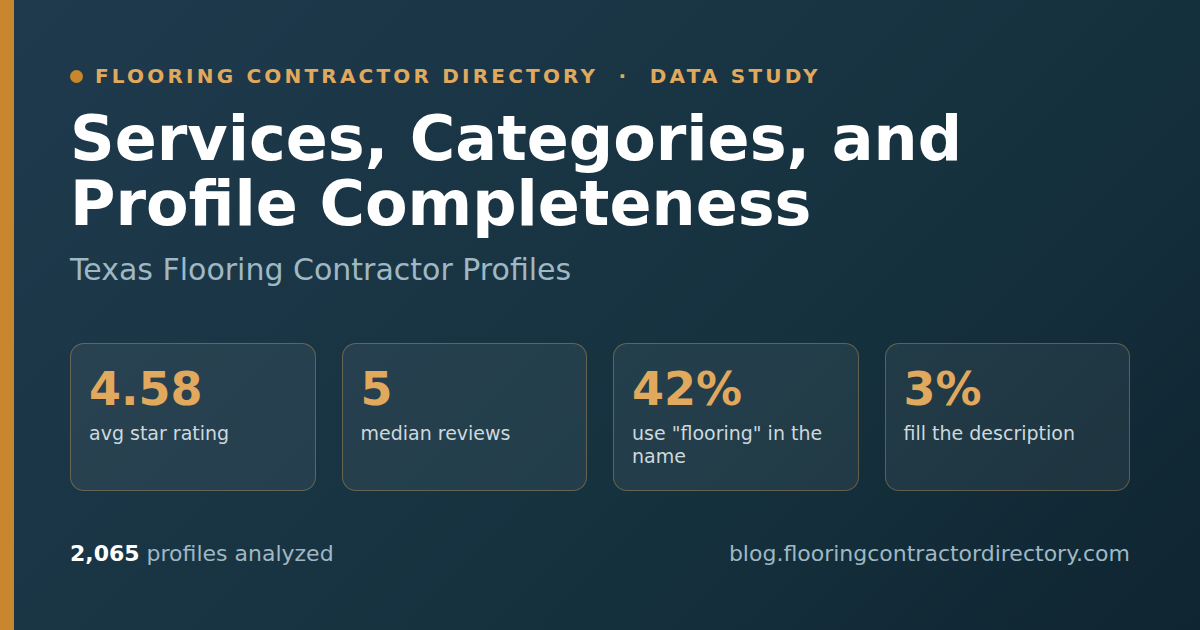
Table of contents
Abstract
This study reads the category labels, service menus, and profile completeness that Texas flooring contractors publish on their Google Business Profiles, asking what they say they do and how fully they fill in the fields Google gives them. We examined 2,065 flooring contractor profiles in the sample and found a market that crowds under one generalist label: 1,523 contractors pick the broad "Flooring contractor" primary category, while the specialists trail far behind at 284 tile contractors, 80 carpet installers, and 73 floor refinishing services. The headline finding is one of sameness and sprawl: nearly everyone competes from the same generic category, then pads the service list with adjacent trades rather than sharpening their flooring story.
The service menus confirm the sprawl. Core flooring work leads, with Install flooring at 454, Tile work installation at 320, and Repair flooring at 316, but Remodeling at 331 outranks two of those, and the list quickly bleeds into drywall, painting, and other handyman trades that dilute the flooring signal. On completeness, profiles cover the basics well: 2,013 of them show photos (97.5%) and 1,544 list a website (74.8%), while just over half, 1,075 profiles (52%), publish any services at all. The single largest and most fixable gap is the business description: only 70 contractors, a mere 3.4% of the sample, have filled it in, leaving the one free field where a contractor can tell its own story almost universally blank.
Methodology and Sample
This study looks at what Texas flooring contractors actually put on their Google Business Profiles: the primary category they file under, the services they list, and how completely they fill out the profile at all. We pulled the publicly visible profile fields for 2,065 flooring contractors across Texas, then tallied categories, service line items, and four completeness signals. The goal is to show, with real numbers, how thorough the average flooring profile really is and where the trade leaves easy ground uncovered.
Data and method
The population is flooring contractors only. We started from a statewide pull of 2,065 contractors and filtered to genuine flooring, tile, carpet, and refinishing businesses. General contractors, roofers, carpet-cleaning-only outfits, and pure retail stores were excluded, so what we measured reflects the flooring trade itself and not some adjacent business that happens to touch a floor.
Across those 2,065 contractors we measured three things, each pulled straight from the profile and counted, never estimated:
- Primary categories. Every profile carries a Google-assigned primary category. We tallied the categories across all 2,065 contractors to see how the trade sorts itself, from the broad Flooring contractor label down to the narrow specialists.
- Services listed. For each profile that publishes a services list, we counted the individual service line items it advertises, then ranked them statewide. This is what tells us which jobs contractors choose to put in front of a searcher.
- Completeness fields. We checked four profile fields and counted how many of the 2,065 profiles populate each one: a website link (1,544 profiles), photos (2,013), a services list (1,075), and a written description (70).
The counting is deterministic. Every category total, every service rank, and every completeness count comes directly from the profile data, so the statistics stay honest and nothing is invented to fit a narrative.
Limitations
A study is only as trustworthy as the caveats it owns up front. Read the service numbers below as directional coverage, not as a full inventory of what each business can do:
- The services list is far from universal. Only 1,075 of 2,065 profiles (52%) publish a services list at all, so every service count undercounts the real offerings in the trade. A contractor who installs hardwood but never typed it into the services field is invisible to that tally.
- The description sample is tiny. Only 70 profiles carry a written business description, so we lean on descriptions only lightly and never build a headline number on them.
- Photo presence, not photo quality. We counted whether a profile has photos, not whether those photos are good, recent, or relevant. A single blurry upload counts the same as a full portfolio.
The Flooring Contractor Landscape
Before you can read a single rating or review, the first question a Google Business Profile answers is a blunt one: what does this business actually do? That answer lives in two fields, the primary category and the services list, and together they shape almost every local search a contractor can win. To understand how Texas flooring contractors compete, this study pulled the categories and services off 2,065 flooring contractor profiles and counted them. The picture that emerges is not a field of focused specialists. It is a crowded market where one broad label does the heavy lifting and where a striking share of "flooring" businesses are really home-improvement generalists with floors as one line item among many.
Category mix
Google lets a business pick a single primary category, the one that anchors its identity in Maps and the local pack, and the choice across these 2,065 contractors is heavily concentrated. The generalist "Flooring contractor" label dominates, claimed by 1,523 profiles, roughly three out of every four businesses in the sample. Everything else is a long, thin tail of more specialized trades.
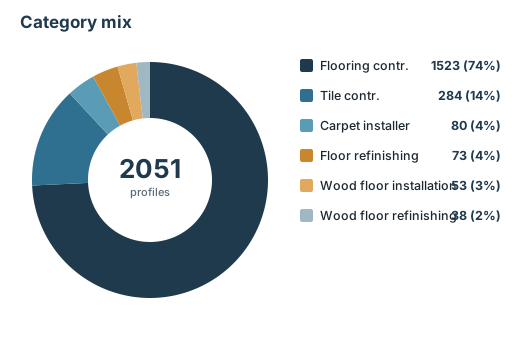
Behind the dominant label, the specialist categories rank like this:
- Flooring contractor: 1,523 profiles, the generalist default that absorbs the bulk of the market.
- Tile contractor: 284, by far the largest specialist niche and the only one to clear two hundred.
- Carpet installer: 80, a focused trade that has thinned out as carpet has lost share to hard surfaces.
- Floor refinishing service: 73, contractors who restore existing floors rather than install new ones.
- Wood floor installation service: 53, hardwood specialists positioning on a single material.
- Wood floor refinishing service: 38, an even narrower sand-and-finish niche.
The takeaway is plain. Add the six specialist categories together and they still fall well short of the 1,523 businesses sitting under the single generic label. Tile is the only niche with real depth at 284, while wood and carpet specialists are scarce. For a contractor, that concentration cuts both ways. The broad category is the safe choice because it matches the widest set of searches, but it also means competing head to head with fifteen hundred near-identical profiles for the same generic "flooring contractor near me" query, with nothing in the category field to set you apart.
Services: the generalist pattern
If the category field hints that these businesses are broad, the services field confirms it. A profile's listed services are individual checkboxes the owner adds, and they reveal what a business genuinely wants to be hired for. The most common services are exactly what you would expect from a flooring trade. "Install flooring" leads everything at 454 mentions, with "tile work installation" at 320, "repair flooring" at 316, and "tile work replacement" at 275. So far, so focused: core flooring work sits firmly at the top of the list.
But sitting right alongside those core services are trades that have nothing to do with floors at all. "Remodeling" appears 331 times, ranking second overall and edging out tile installation. Below it the adjacent trades stack up fast: drywall repair at 213, exterior painting at 206, paint indoors at 199, drywall installation at 187, and plumbing fixture installation at 150. None of those is a flooring service. Every one of them is general renovation, finish, or handyman work.
The full top ten services make the blend impossible to miss:
- Install flooring: 454 (core flooring)
- Remodeling: 331 (adjacent trade)
- Tile work installation: 320 (core flooring)
- Repair flooring: 316 (core flooring)
- Tile work replacement: 275 (core flooring)
- Drywall repair: 213 (adjacent trade)
- Exterior painting: 206 (adjacent trade)
- Paint indoors: 199 (adjacent trade)
- Drywall installation: 187 (adjacent trade)
- Plumbing fixture installation: 150 (adjacent trade)
Half of the ten most common services are not flooring at all. The real-world profiles bear this out: one homeowner describes a single contractor who handled "Bath and flooring" together, repaired ceiling damage, painted, and fixed a roof leak, all on one job. Another recounts a crew that "replaced ceramic tile flooring with luxury vinyl throughout the house, replaced bathroom tile and updated master shower" and "also painted the whole interior of the house." The services data is not an accident of how Google labels things. It is contractors deliberately stacking remodeling, drywall, painting, and plumbing onto a flooring profile to catch a wider net of renovation demand.
What this means for positioning
Read together, the categories and services point to one conclusion: many of these businesses do not position themselves as flooring specialists at all. They present as broad home-improvement operators who happen to lay floors, and they pad their service lists with remodeling, drywall, painting, and plumbing to capture whatever renovation work walks through the door. That is a rational survival strategy for a small crew that needs to stay busy, but it carries a real cost in local search.
When 1,523 contractors share the same generic primary category and the second most listed service across the entire market is the catch-all "remodeling" at 331, the profiles start to blur together. Generalist breadth is easy to claim and impossible to rank on, because everyone is claiming the same wide territory at once. The contractors with room to stand out are the ones leaning into a focused niche the crowd has thinned out, the 284 tile specialists, the 53 hardwood installers, the 73 refinishers, where the category itself does some of the differentiating work. The broad label wins the most searches in theory and the fewest in practice. The narrow one is where a profile actually gets to look specific.
Profile Completeness
A Google Business Profile is a stack of fields, and a flooring contractor does not have to fill all of them to rank, but every blank field is a question Google and a homeowner have to answer somewhere else. Across the 2,065 Texas flooring contractors in this sample, the encouraging news is that most cover the visible basics: nearly everyone has a photo, three out of four point to a website, and about half list their services. The discouraging news is that one field is almost universally ignored, and it happens to be the one the owner controls completely and can fix for free in a single sitting.
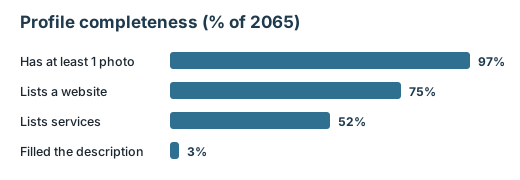
Read across the four fields and the slope is steep. Photos sit at the top with 97.5 percent, websites follow at 74.8 percent, services drop to 52 percent, and the description collapses to 3.4 percent. The effort each field demands runs in roughly the same order, which is exactly why the description, the cheapest field of the four, ends up the emptiest.
Websites and photos
Of the 2,065 contractors, 1,544 list a website, or about 74.8 percent. That sounds healthy, and by directory standards it is, but it still leaves roughly a quarter of profiles with no link out to a site at all. For those businesses the Google Business Profile is not the front door to a website; it is the website. Every question a homeowner might have, about materials, financing, service area, or warranty, has to be answered inside the profile itself or not at all, which makes the emptier fields below hurt that much more.
Photos are the one field almost nobody skips. 2,013 of 2,065 profiles carry at least one image, about 97.5 percent, so a missing photo is the exception rather than the rule. The interesting story is not presence but depth, and depth varies enormously:
- 52 profiles still show zero images, the small but real bottom of the field.
- The median profile holds just 28 photos, a modest library for a trade that sells a visual result.
- At the same time, 821 contractors sit in the 50-plus band, carrying deep galleries of finished floors.
So the photo gap is not about whether a contractor has uploaded anything; almost all of them have. It is about the contractors clustered down at the low end, where a handful of stock-looking shots stands in for a portfolio. For a category where the customer is buying a look, the difference between a thin gallery and a deep one is the difference between a homeowner imagining the finished room and clicking away to a competitor who showed them.
The description gap
The standout weakness, by a wide margin, is the description field. Only 70 of the 2,065 contractors have written one, which is about 3.4 percent. Flip that around and it means more than 96 percent of Texas flooring contractors leave the description completely blank. Nearly the entire field is staring at an empty box where a few sentences about who they are and what they install should be.
This is not a hard field. It is not gated behind verification, it does not require a website, a photographer, or a third-party asset of any kind. It is free text that the owner types in and fully controls, and yet it is the single most-skipped item on the profile. The numbers make the contrast almost absurd: 97.5 percent of these businesses managed to upload a photo, an act that takes a phone and a job site, while only 3.4 percent typed a paragraph that takes nothing but a few minutes.
Why this gap matters
Every other completeness field carries a built-in excuse. A website costs money or time to build, which is why a quarter of profiles go without one. A deep photo library takes finished jobs and the discipline to document them, which is why so many sit at the thin end. Even a full services list takes a contractor sitting down to map their offerings onto Google's menu. The description has none of those barriers.
That is what makes the empty description both the largest completeness gap in the data and the most fixable one. It is the rare lever where the cost is near zero, the control is total, and the competition is doing almost nothing: in a field where more than 96 percent leave it blank, a contractor who writes a clear, keyword-honest paragraph about their service, their materials, and their service area is not matching the field, they are stepping in front of it. When three of the four basics demand money, assets, or finished work, the one free field that almost everyone ignores is the obvious first move.
Conclusions: A Blueprint to Adapt
The completeness numbers in this study are not a report card, they are a map of open ground. Across 2,065 Texas flooring contractors, the same fields sit empty again and again, which means the things that would make a profile stand out are the very things almost no one bothers to fill in. What follows is not a rigid checklist to copy line by line. It is a blueprint of principles to adapt to your own business and your own market, framed by the questions worth asking the next time you look at your own listing.
A blueprint for contractors
Read the empty fields as opportunity, not as chores. The data says most of your competitors are leaving the easiest wins on the table. A strong contractor works the levers in order of cost: start with the free fields that almost no one uses, then make sure the profile actually describes everything you do.
Fill the free fields first
The single most striking gap in the entire dataset is the business description. Only 70 of 2,065 contractors wrote one, just 3.4 percent. This is a field that costs nothing, takes a few minutes, and is the cheapest way to stand apart in a crowd where more than 96 percent of profiles say nothing about themselves at all. If you do only one thing after reading this, write your description.
Questions to ask yourself
- The description: does your profile explain who you are, what you specialize in, and the areas you serve, in your own words? With only 3.4 percent of Texas flooring contractors using this field, a few honest sentences make you visibly more complete than nearly everyone you compete against.
- The website: roughly one in four contractors has no website at all. 1,544 of 2,065, about 74.8 percent, link one. If you are in the missing 25 percent, a customer comparing two listings has nowhere to learn more about you. A simple site is not optional differentiation, it is table stakes.
These two fields are the cheapest fixes in the study. One is free, the other is close to it, and together they move you out of the silent majority and into the small group of profiles that actually tell a customer something.
How to use this
Treat each point as a direction to adapt, not a fixed rule. Start where the gap between your profile and the data above is widest.
List your full service set
Only 1,075 of 2,065 contractors, about 52 percent, list any services on their profile. That means roughly half of Texas flooring contractors are invisible for the specific work a homeowner is searching for, whether that is install, repair, refinishing, or tile. Listing your services is how you get matched to the exact job someone wants done.
Questions to ask yourself
- Coverage: does your service list reflect everything you actually do, or just the headline category? If you install and repair and refinish, all three belong on the profile.
- Honesty: the goal is a complete list of real work, not a padded one. A profile that names the services you genuinely offer is what turns a search into a phone call.
The pattern across all three levers is the same: completeness is the differentiator. The description, the website, and the service list are not separate chores. They are one habit, the habit of tending your presence, and almost no one is doing it. That is your opening.
A blueprint for homeowners
You do not need a contractor to be perfect on paper. You need to read the profile for effort, because a fuller listing usually points to an owner who pays attention.
- A fuller profile is a good sign. Photos, a listed service set, and a written description together suggest an owner who tends their presence. Most do not: only 3.4 percent wrote a description and only 52 percent list services, so the ones who do stand out for a reason.
- Photos are the baseline, not the differentiator. Nearly everyone has them: 97.5 percent of profiles include photos. Their presence is expected, so look past them to the fields most contractors skip.
- Sparse profiles are not disqualifying. A missing website (about one in four have none) or an empty description does not mean bad work. It just means you have less to go on, so ask more questions before you hire.
Put this report to work
For homeowners: see these patterns in real listings. Browse the directory's Texas flooring contractors to compare reviews and ratings for yourself, and read how the directory works before you reach out.
For contractors: the patterns above are your opening. List your business in the directory, and if you need a stronger online presence, get a flooring website so customers can find you.
Frequently Asked Questions
What categories do Texas flooring contractors use on Google?
Across the 2,065 Texas flooring contractors in this study, the primary category is overwhelmingly "Flooring contractor", chosen by 1,523 profiles. The next most common is "Tile contractor" at 284 profiles, followed by "Carpet installer" (80), "Floor refinishing service" (73), and "Wood floor installation service" (53). The clear takeaway is that the great majority of these businesses anchor themselves to the broad flooring contractor category, while a meaningful minority pick a more specific niche like tile, carpet, or wood floor work to signal a specialty.
Do Texas flooring contractors offer services beyond flooring?
Many do. Among the services these profiles list, the most common are exactly what you would expect, "Install flooring" at 454 mentions and "Repair flooring" at 316 mentions, alongside tile work such as "Tile work installation" (320) and "Tile work replacement" (275). But the second most listed service overall is "Remodeling" at 331 mentions, and the list runs well past flooring into "Drywall repair" (213), "Exterior painting" (206), "Paint indoors" (199), "Drywall installation" (187), and even "Plumbing fixture installation" (150). In short, a large share of Texas flooring contractors position themselves as broader remodeling and home improvement businesses, not flooring only.
How complete are the Google Business Profiles of Texas flooring contractors?
Completeness is uneven. The basics are nearly universal: 2,013 of 2,065 profiles (97.5%) have at least one photo. A solid majority, 1,544 (74.8%), link to a website, and about half, 1,075 (52%), list any services at all. But the business description, a field the owner has to write, is almost always left blank: only 70 profiles (3.4%) filled it in. So the typical Texas flooring profile is photo rich and usually has a website, but is often missing the services list and almost always missing the written description.
What share of Texas flooring contractors fill in the business description?
Very few. Just 70 of the 2,065 profiles (3.4%) have a business description written on their Google Business Profile. That makes the description the single most neglected field in the entire study, and it represents one of the easiest, lowest cost ways for a contractor to stand out, because more than 96% of the competition has left that space empty.
How many photos does a typical Texas flooring profile have?
The typical profile is well stocked with photos. The median Texas flooring contractor has 28 photos on its Google Business Profile, and 2,013 of 2,065 profiles (97.5%) have at least one photo. Because nearly every profile carries photos, simply having images is table stakes rather than a differentiator. The realistic goal is to be on the higher side of that distribution with a genuinely current, well organized photo set rather than just clearing the bare minimum.
Do most Texas flooring contractors list a website?
Yes, most do, but not all. 1,544 of the 2,065 profiles (74.8%) link to a website from their Google Business Profile. That leaves roughly one in four contractors with no website link at all, relying entirely on the profile itself to capture and convert searchers. For a homeowner, a missing website is not automatically a red flag, but for a contractor it is a clear gap, since the website link is one of the most direct paths from a Google search to a booked job.
Which fields should a Texas flooring contractor fix first?
Fix the fields the competition ignores. Photos are already nearly universal at 97.5%, so they are necessary but not where the edge is. The biggest open opportunities are the business description, filled in by only 3.4% of profiles, and the services list, present on just 52%. After that, the roughly one in four contractors without a website (only 74.8% have one) should add that link. Writing a real description, listing services like install flooring, repair flooring, and remodeling, and adding a website are the three highest leverage moves, precisely because so many Texas flooring profiles still leave them undone.
Related Reports
Keep exploring the Texas flooring data network: