Flooring Contractors in Houston: A Google Business Profile Data Study
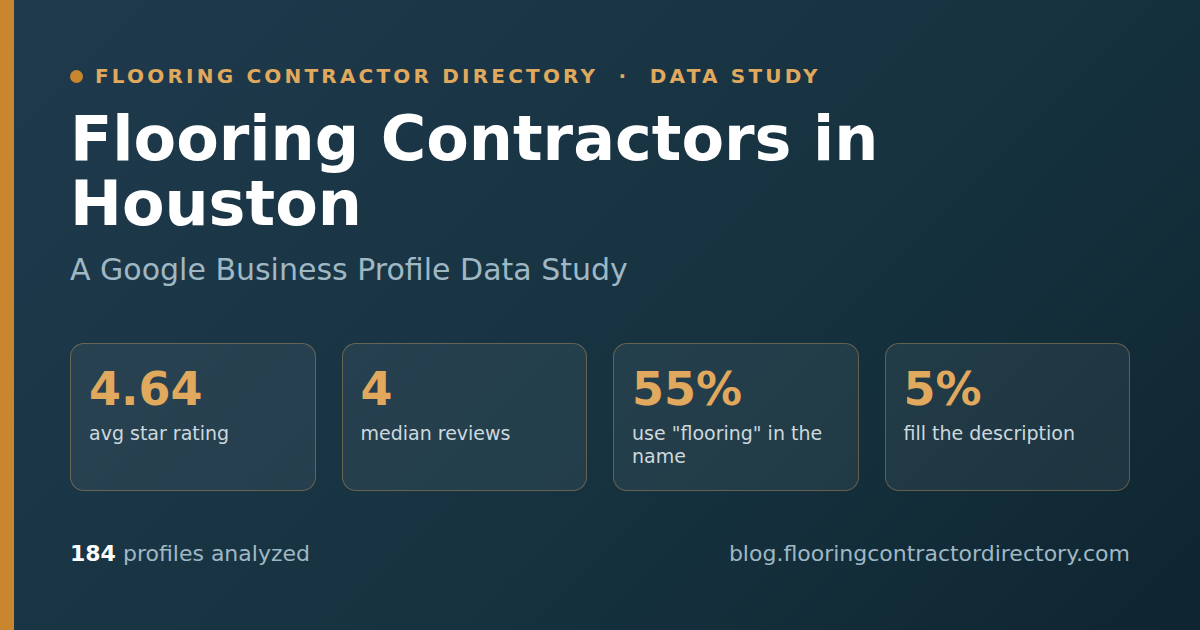
Table of contents
Abstract
This study profiles the Houston flooring market as Google sees it, reading the public Business Profiles of 184 flooring contractors to map how they rate, how visible they are, what they call themselves, and how much of their profile they actually fill in. The headline is a market that looks excellent on average yet hides a steep visibility gap: most profiles carry strong stars, but only a handful own the reviews and the search real estate.
On reputation, the picture is bright. Across the 149 Houston contractors that show a rating, the average is 4.64 stars, and 110 of the 184 profiles have at least one review. The catch is concentration. Review volume is wildly lopsided: the median contractor has just 4 reviews, while the mean sits at 51.8, a gap that only happens when a small group of profiles hoards hundreds of reviews and pulls the average up while the typical contractor sits nearly invisible. We scanned 674 visible reviews to read the language behind those numbers.
On positioning, the surprise runs the other way. Keyword adoption is higher than you might expect: 101 of the 184 businesses (54.9%) put "floor" or "flooring" right in the business name, so more than half are already signaling their category to Google at the name level. Where Houston contractors leave easy ground on the table is the description field: just 9 of 184 profiles (4.9%) have filled it in, meaning roughly 19 in 20 hand Google a blank where they could be feeding it relevant text. The takeaway for contractors and homeowners alike: in Houston, a good rating is table stakes, the real separation comes from review volume and a fully completed profile.
Methodology and Sample
This study looks at how flooring contractors in Houston, Texas show up on Google, using only the data a customer can see for themselves. We pulled the public Google Business Profile fields for flooring contractors geolocated to Houston, then measured the categories they pick, the services they list, the ratings and review counts they carry, what their reviewers actually wrote, how they name their businesses, and whether they bothered to fill in a website, photos, and a description. The aim is to show, with real numbers, what a strong Houston flooring profile looks like and where most local profiles fall short.
Data and method
The population is flooring contractors only. We built a Houston sample of 184 contractors and filtered it to genuine flooring, tile, carpet, and refinishing businesses. General contractors, roofers, carpet-cleaning-only outfits, and pure retail stores were excluded so the patterns we measured reflect the flooring trade and not some adjacent business. Houston is a single metro sample, so it is smaller and more focused than a statewide pull.
Of the 184 contractors in the Houston sample, 149 carry a visible star rating and 110 show at least one review. The profiles that are live but silent are themselves a finding we return to later. Across the profiles that do have reviews, we scanned 674 individual review texts.
We read each profile across the same public fields for every business:
- Profile structure. The primary and secondary categories a contractor selects, and the services they list, since these are the fields Google uses to understand what a business does.
- Reputation signals. The profile-level star rating and the review count, plus the text of the reviews themselves.
- Completeness. Whether each profile has a website, photos, and a written description.
- Business names. The words contractors put in their names, such as floor, tile, hardwood, and epoxy.
The method has two layers, and we keep them separate on purpose:
- Deterministic counts. Every number in this study is a straight tally from the profile data: how many contractors sit in each rating band, how many list a given service, how often a fixed dictionary of complaint and praise words shows up across all 674 reviews. The word list was set in advance so no theme was cherry-picked after seeing the data.
- Verbatim quotes. To illustrate each theme we pulled actual review sentences, word for word, straight from the profiles. Every quote in this study is a real Houston customer's text, not a paraphrase or a composite.
Keeping the counting apart from the quoting means the statistics stay honest and the examples stay real. Nothing here is invented to fit a narrative.
Limitations
A study is only as trustworthy as the caveats it owns up front. Houston is a focused, single-metro sample, so read every number below as directional rather than as a precise sentiment score:
- Smaller city sample. The Houston set is 184 contractors, with 149 rated and 110 showing reviews. That is plenty to read the broad patterns, but fine-grained bands (for example a single rating tenth or a narrow review-count tier) should be treated as directional, not exact.
- Visible reviews only. We measured the reviews each profile actually shows publicly, which is not necessarily every review the business has ever received.
- Relative dates only. Review timestamps came through as relative phrases like "4 months ago," so we cannot pin reviews to exact calendar dates or build a precise timeline.
- No per-review star ratings. Individual review star scores were not available, so we cannot tie a specific word to a specific 1 to 5 rating. Word counts stand in for sentiment, which is why we call them directional.
- Descriptions are rare. A written profile description was present on only a handful of Houston profiles, so any reading of description content is limited to those few and is not representative of the whole sample.
The Houston Flooring Landscape
Before a homeowner reads a single rating or review, the first question a Google Business Profile has to answer is a blunt one: what does this business actually do? That answer lives in two fields, the primary category and the services list, and together they shape almost every local search a Houston contractor can win. To see how the city's flooring trade competes, this study pulled the categories and services off 184 Houston flooring contractor profiles and counted them. The picture is familiar from the wider Texas market: not a field of focused specialists, but a crowded local pack where one broad label does most of the work and where a striking share of "flooring" businesses are really home-improvement generalists with floors as one line item among several.
Category mix
Google lets a business pick a single primary category, the one that anchors its identity in Maps and the Houston local pack, and the choice across these 184 contractors is heavily concentrated. The generalist "Flooring contractor" label dominates, claimed by 120 profiles, roughly two out of every three businesses in the sample. Everything else is a long, thin tail of more specialized trades.
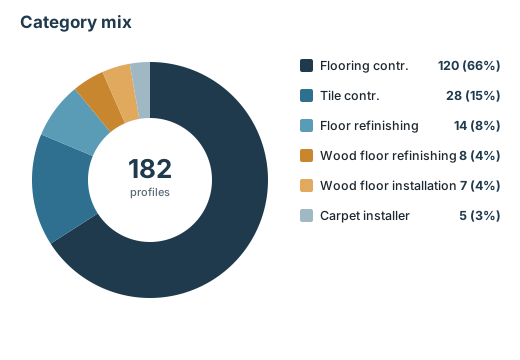
Behind the dominant label, the specialist categories rank like this:
- Flooring contractor: 120 profiles, the generalist default that absorbs the bulk of the Houston market.
- Tile contractor: 28, by far the largest specialist niche and the only one to clear two dozen.
- Floor refinishing service: 14, contractors who restore existing floors rather than install new ones.
- Wood floor refinishing service: 8, a narrower sand-and-finish niche built on hardwood restoration.
- Wood floor installation service: 7, hardwood specialists positioning on a single material.
- Carpet installer: 5, a focused trade that has thinned out as carpet loses share to hard surfaces.
- Floor sanding and polishing service: 2, the narrowest niche in the city sample.
The takeaway is plain. Add the six specialist categories together and they still fall well short of the 120 businesses sitting under the single generic label. Tile is the only niche with any real depth at 28, while wood and carpet specialists are scarce, never breaking into double digits on their own. For a Houston contractor, that concentration cuts both ways. The broad category is the safe choice because it matches the widest set of searches, but it also means competing head to head with one hundred and twenty near-identical profiles for the same generic "flooring contractor near me" query, with nothing in the category field to set you apart.
Services: the generalist pattern
If the category field hints that these businesses are broad, the services field confirms it. A profile's listed services are individual checkboxes the owner adds, and they reveal what a business genuinely wants to be hired for. Of the 184 Houston profiles, 94 filled this field in at all, and the most common entries are exactly what you would expect from a flooring trade. "Install flooring" leads everything at 40 mentions, with "tile work installation" at 29, "repair flooring" at 27, and "tile work replacement" at 22. So far, so focused: core flooring work sits firmly at the top of the list.
But sitting right alongside those core services are trades that have little or nothing to do with floors. "Remodeling" appears 20 times, ranking fifth overall and ahead of every hardwood and carpet service. Below it the adjacent trades stack up: "paint indoors" at 10, "exterior painting" at 8, and even "water damage" at 9. None of those is a flooring service. Every one of them is general renovation, finish, or restoration work, padded onto a flooring profile to widen the net.
The full top ten services make the blend clear:
- Install flooring: 40 (core flooring)
- Tile work installation: 29 (core flooring)
- Repair flooring: 27 (core flooring)
- Tile work replacement: 22 (core flooring)
- Remodeling: 20 (adjacent trade)
- Wood floor installation: 14 (core flooring)
- Carpet installation: 13 (core flooring)
- Ceramic tile flooring installation: 13 (core flooring)
- Laminate floor installation: 12 (core flooring)
- Free Estimate: 12 (sales offer, not a trade)
Push a little further down the list and the spread of materials and side trades widens again: "flooring repair" at 11, "ceramic tile" at 11, "wood floor tile installation" at 10, "paint indoors" at 10, then "stair flooring," "wood floor refinishing," "vinyl flooring," "water damage," and "residential and commercial" all tied at 9 each. The real-world reviews bear the pattern out. One Houston homeowner describes a contractor who "remodeled the entire area" covering the living room, kitchen, and dining room in a single job, while another recounts a crew that handled "a complete remodel of our home" through power outages and a hurricane. The services data is not an accident of how Google labels things. It is contractors deliberately stacking remodeling, painting, and restoration onto a flooring profile to catch a wider net of renovation demand.
What this means for positioning
Read together, the categories and services point to one conclusion: many Houston flooring businesses do not position themselves as flooring specialists at all. They present as broad home-improvement operators who happen to lay floors, leaning on "remodeling" (20), painting, and water-damage work to capture whatever renovation job walks through the door. That is a rational survival strategy for a small crew that needs to stay busy, but it carries a real cost in local search.
When 120 of 184 contractors share the same generic primary category, the profiles start to blur together. Generalist breadth is easy to claim and almost impossible to rank on, because everyone is claiming the same wide territory at once. The contractors with room to stand out in Houston are the ones leaning into a focused niche the crowd has thinned out, the 28 tile specialists, the 14 refinishers, the 7 hardwood installers, where the category itself does some of the differentiating work. The broad label wins the most searches in theory and the fewest in practice. The narrow one is where a Houston profile actually gets to look specific.
Profile Completeness
A Google Business Profile is a stack of fields, and a Houston flooring contractor does not have to fill every one to rank, but each blank field is a question Google and a homeowner have to answer somewhere else. Across the 184 Houston flooring contractors in this sample, the encouraging news is that most cover the visible basics: almost everyone has a photo, roughly four out of five point to a website, and about half list their services. The discouraging news is that one field is almost universally ignored, and it happens to be the one the owner controls completely and can fix for free in a single sitting.
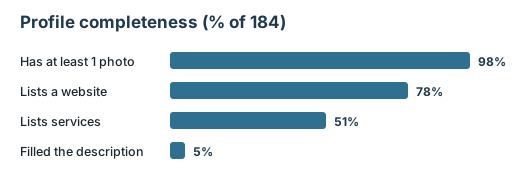
Read across the four fields and the slope is steep. Photos sit at the top with 97.8 percent, websites follow at 78.3 percent, services drop to 51.1 percent, and the description collapses to 4.9 percent. The effort each field demands runs in roughly the same order, which is exactly why the description, the cheapest field of the four, ends up the emptiest in Houston.
Websites and photos
Of the 184 Houston contractors, 144 list a website, or about 78.3 percent. That sounds healthy, and by directory standards it is, but it still leaves roughly one in five profiles with no link out to a site at all. For those businesses the Google Business Profile is not the front door to a website; it is the website. Every question a Houston homeowner might have, about materials, financing, service area, or warranty, has to be answered inside the profile itself or not at all, which makes the emptier fields below hurt that much more.
Photos are the one field almost nobody skips. 180 of 184 profiles carry at least one image, about 97.8 percent, so a missing photo is the exception rather than the rule. The interesting story is not presence but depth, and depth varies enormously:
- 4 profiles still show zero images, the small but real bottom of the field.
- The median Houston profile holds just 19 photos, a modest library for a trade that sells a visual result.
- At the same time, 65 contractors sit in the 50-plus band, carrying deep galleries of finished floors.
So the photo gap is not about whether a Houston contractor has uploaded anything; almost all of them have. It is about the contractors clustered down at the low end, where a handful of stock-looking shots stands in for a portfolio. For a category where the customer is buying a look, the difference between a thin gallery and a deep one is the difference between a homeowner imagining the finished room and clicking away to a competitor who showed them.
The description gap
The standout weakness, by a wide margin, is the description field. Only 9 of the 184 Houston contractors have written one, which is about 4.9 percent. Flip that around and it means more than 95 percent of Houston flooring contractors leave the description completely blank. Nearly the entire field is staring at an empty box where a few sentences about who they are and what they install should be.
This is not a hard field. It is not gated behind verification, it does not require a website, a photographer, or a third-party asset of any kind. It is free text that the owner types in and fully controls, and yet it is the single most-skipped item on the profile. The numbers make the contrast almost absurd: 97.8 percent of these businesses managed to upload a photo, an act that takes a phone and a job site, while only 4.9 percent typed a paragraph that takes nothing but a few minutes.
Why this gap matters
Every other completeness field carries a built-in excuse. A website costs money or time to build, which is why one in five Houston profiles go without one. A deep photo library takes finished jobs and the discipline to document them, which is why so many sit at the thin end. Even a full services list takes a contractor sitting down to map their offerings onto Google's menu. The description has none of those barriers.
That is what makes the empty description both the largest completeness gap in the Houston data and the most fixable one. It is the rare lever where the cost is near zero, the control is total, and the competition is doing almost nothing: in a field where more than 95 percent leave it blank, a Houston contractor who writes a clear, keyword-honest paragraph about their service, their materials, and their service area is not matching the field, they are stepping in front of it. When three of the four basics demand money, assets, or finished work, the one free field that almost everyone ignores is the obvious first move.
Ratings and Review Volume
Reputation is the first thing a Houston homeowner reads before they ever click a flooring contractor's name in Google. It arrives as two numbers sitting side by side: the star rating and the review count. They look like one signal, but across the 184 Houston flooring contractor profiles in this study they behave nothing alike. One is so compressed it barely separates anyone. The other runs across two full orders of magnitude and quietly decides which contractor gets the call. This section pulls the two apart and shows why the number most Houston contractors fixate on is the one that matters least.
Ratings cluster near the ceiling
Of the 149 Houston profiles that carry a star rating at all, the average sits at 4.64. On its own that looks like a meaningful score. It is not. The moment you split it into bands, the distribution turns out to be jammed against the top of the scale, with almost no room left to tell one flooring contractor apart from the next.
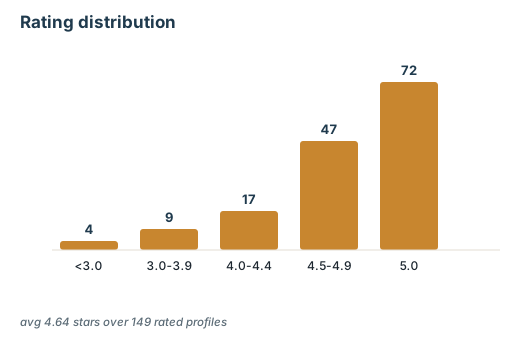
Look at how lopsided the bands are. A full 72 profiles, the largest group of all, hold a perfect 5.0, and another 47 land in the 4.5 to 4.9 range. Stack those together and 119 of the 149 rated profiles, four out of every five, sit at 4.5 stars or higher. The lower bands are nearly empty by comparison:
- 5.0 stars: 72 profiles, the single biggest band.
- 4.5 to 4.9 stars: 47 profiles.
- 4.0 to 4.4 stars: 17 profiles.
- 3.0 to 3.9 stars: 9 profiles.
- Below 3.0 stars: only 4 profiles.
The bottom of the scale barely exists. Only 4 profiles fall below 3.0, which means a Houston homeowner scanning flooring contractors sees a wall of 4.5-and-up ratings with the rare outlier. When a perfect 5.0 is the most common outcome on the entire scale, the star rating stops working as a comparison tool. Everyone looks excellent, so excellent stops meaning anything.
There is a quieter reason the ceiling stays so crowded, and it shows up in the review language itself: praise words dominate the Houston verbatim reviews by enormous margins, while complaints are scarce. The people who bother to leave a review are mostly happy. That self-selection pushes nearly every profile that has any reviews at all toward the top of the scale, which is exactly why the Houston rating compresses the way it does.
The takeaway
The 4.64 average is statistical noise for the purpose of choosing a Houston contractor. With four in five rated profiles at 4.5 or better and a perfect 5.0 as the most common single result, a high star rating is the price of entry, not a differentiator. It tells you a contractor is not actively disliked. It does not tell you they are trusted, established, or busy. For that you have to look at the number next to the stars.
Review volume is the real signal
Review count is where the real separation lives in Houston, and it is dramatic. The median Houston flooring contractor has just 4 reviews. The average is 51.8. When the mean is roughly thirteen times the median, you are not looking at a normal spread, you are looking at a heavy right skew: a small number of high-volume profiles dragging the average far above where the typical contractor actually sits.
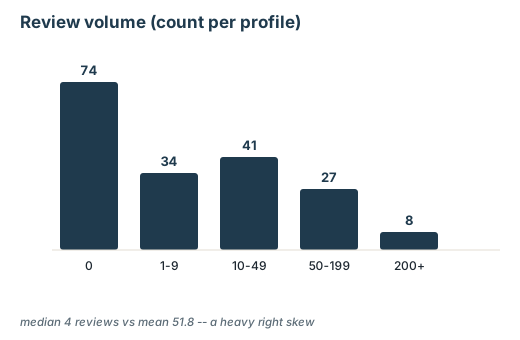
The bands explain the gap between the median and the mean better than either number can alone:
- 0 reviews: 74 profiles, the largest group on the chart.
- 1 to 9 reviews: 34 profiles.
- 10 to 49 reviews: 41 profiles.
- 50 to 199 reviews: 27 profiles.
- 200 or more reviews: only 8 profiles.
Start with the bottom. 74 of the 184 profiles, two in five, have zero reviews. Add the 34 with one to nine, and 108 contractors, well over half the entire Houston field, sit at fewer than ten reviews. That is what drives the median down to 4. For a homeowner, a profile in this range carries almost no social proof. It is a name and a star rating built on a handful of opinions, easy to scroll past in favor of the contractor right below it with a few hundred.
Now the top. Only 8 profiles, fewer than five percent of the Houston field, have reached 200 reviews or more. This tiny group is doing almost all the heavy lifting on the average. A single several-hundred-review profile offsets dozens of profiles with zero, which is precisely how a median of 4 and a mean of 51.8 can describe the same population. The 50-to-199 band adds another 27 genuinely established profiles, but together with the 200-plus group they are still the visible minority. The middle 10-to-49 band holds 41 contractors, the realistic on-ramp where a Houston profile starts to look credible without yet being dominant.
Why volume beats the average
Star ratings compress; review counts expand. That is the whole story in Houston. Because nearly every rated profile lands at 4.5 or above, the rating cannot tell two contractors apart. Review volume can, and does, across a range that runs from zero to the hundreds. It is the clearest evidence on the entire Google Business Profile that a business has actually done the work, served real Houston customers, and is still operating at scale.
The gap is also where the opportunity sits. With 74 Houston profiles at zero and a median of just 4, the bar to climb out of the invisible majority is astonishingly low. A contractor does not need to chase the 8 profiles in the 200-plus band to win the comparison on a search results page. Moving from zero to a steady, modest stream of reviews lifts a profile past more than half the Houston field, because more than half the field is stuck below ten. The star average will take care of itself, as the data shows it nearly always does. The number worth building is the one beside it.
What Houston Reviews Reveal
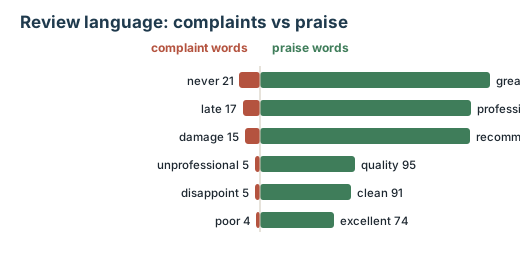
We read the visible review text across 674 reviews on Houston flooring contractor Google Business Profiles, then counted how often customers reached for specific complaint and praise words. The clearest finding is one of proportion: praise vocabulary does not merely edge out complaint vocabulary in Houston, it overwhelms it. The single most common praise word, great, appears 230 times, more than ten times the most frequent complaint word, never, which shows up just 21 times. Line the entire praise column up against the entire complaint column and the gap only widens. That tells you something durable about this trade in Houston: most flooring jobs end with a satisfied homeowner, and the ones that go wrong tend to fail on the same short, predictable, avoidable list of things.
What customers complain about
The complaint vocabulary is small but strikingly consistent. Read the top of the list and a single theme jumps out before anything to do with the floor itself: reliability. The three most frequent complaint words are never (21), late (17), and damage (15). Notice what is not at the top: words about the actual flooring product. Houston customers are far more likely to write a low-star review because a contractor failed to show up, ran behind, or broke something than because they disliked the tile. The work, when it happens, is usually fine. The process around it is where contractors lose the room.
No-shows and abandoned jobs
The word never tops the complaint list at 21 mentions, and in context it is rarely neutral. It is the word people use for the appointment that never happened, the callback that never came, and the contractor who never finished. One reviewer was rescued only because a previous crew abandoned the appointment entirely, a clean example of how a competitor's no-show becomes someone else's five-star story:
Thank you Jeff and Marshall for coming to our rescue quickly after another Houston area dustless tile removal company pulled a no show.
Further along the same scale sit the worst cases, where the contractor simply stopped responding once money was involved. One epoxy customer described exactly that vanishing act after the work started to fail:
We didn’t let them finish the project and now Pablo the owner is not answering our calls for a resolution. Stay away from this company.
That review uses the abandonment pattern the data predicts: not a complaint about the floor, but about a promise that was not kept. The lesson for contractors is blunt. Showing up, and staying reachable after the deposit clears, is the lowest bar in this industry and it is the one most negative Houston reviews accuse them of failing.
Lateness and delays
Late sits second on the complaint list at 17 mentions, and it is the connective tissue between the no-show and the damage complaint: a late crew becomes a no-show in the customer's mind by mid-afternoon, and a rushed, behind-schedule crew is the one most likely to cut corners. The reviews describe delay as a slow erosion of trust. One homeowner watched a contractor treat their job as a thing to squeeze between other work:
Come late, leave early saying going for another job. A real professional will complete one job before moving to the next.
The same theme of waiting shows up in the trade-customer reviews of a Houston supplier, where time promised and time delivered were nowhere close:
For truckers- hi my appointment was 20.30pm and I check in 18.15pm and now 22.30pm they are not starting loading my truck yet
The supporting vocabulary tells the same story of frustration compounding over time: unprofessional (5), disappoint (5), poor (4), and worst (3). The word worst in particular tends to attach to a contractor who treated the schedule, and the customer, as an afterthought:
Worst person you can ever contract on a job.
Damage and disappointment
The third complaint word is damage at 15 mentions. Flooring work is invasive by nature, with demo, hauling, and heavy materials moving through finished rooms, so the risk of harming the surrounding home is built into the job. Tellingly, damage also appears constantly in positive Houston reviews, precisely because the crew handled it well, which is the clearest possible signal that homeowners are watching for it. Many of the strongest reviews describe a contractor stepping into water and hurricane damage and making it right:
Had some water/moisture damage to my hardwood floors from hurricane Beryl and needed the work completed quickly to ensure my insurance company would reimburse me.
The flip side is the homeowner left feeling let down. The complaint word disappoint (5 mentions) clusters around broken trust rather than a single dramatic failure. Sometimes it is a question of honesty:
I worked with Zach , but honestly I'm really disappointed he is not an honest man.
And sometimes it is a long, grinding job that never lived up to its quote, the kind of slow-motion failure that pulls in the words damage, late, and disappoint all at once:
We had high hopes for our flooring project with Joe's Hardwood Flooring, but unfortunately, our experience over the past five months has been deeply disappointing.
What customers praise
If the complaint vocabulary is small, the praise vocabulary is an avalanche. The top praise word, great, appears 230 times, with professional (211) and recommend (210) right behind it. What is striking is that the most common praise words are not about the floor either. Just like the complaints, the highest-frequency positive language is about how the contractor behaved: professional, responsive, honest, clean, on time. The product matters, but the behavior is what earns the five stars and the closing line, I highly recommend.
Professionalism and communication
Professional (211 mentions) is the second most common word in the entire Houston dataset, and its companions tell you exactly what local homeowners mean by it. The supporting praise words read like a job description for a trustworthy contractor: knowledgeable (51), friendly (32), responsive (26), and honest (25). Over and over, reviewers reward the contractor who communicates clearly and consistently, the exact inverse of the never-called-back complaint:
From start to finish they were professionals! We had 3 quotes, by far they were the most confident and fairly priced.
The word honest in particular tends to surface alongside money, the moment in any project when trust is most fragile. Houston customers single out the contractor who talked them out of an unnecessary spend:
he was very honest and just told me it’s not worth it to spend this much money on me coming and he gave me a lot of advice.
Reliability as the highest compliment
It is worth pausing on a finer point hidden in the data. Several mid-tier praise words, responsive (26), prompt (15), and timely (12), are simply the mirror image of the top complaints, late and never. The same axis that produces the angriest reviews produces the warmest ones. Showing up on schedule is both the easiest way to fail and one of the most-praised things a Houston flooring contractor can do, captured perfectly here:
They show up when they say they will.
Quality of the finished floor
When customers do talk about the work itself, the language turns to quality (95 mentions), excellent (74), beautiful (59), and perfect (37). These reviews celebrate craftsmanship and the visible, lasting result, often work that survives the homeowner's harshest eye:
The quality of the tile is excelent too.
The word beautiful almost always attaches to the moment of transformation, an old or damaged floor brought back to life, sometimes a century-old one:
Robert refinished our 100 plus year old hardwood floors and we could not have been happier. The service, price and professionalism was awesome.
A clean job site
One of the most revealing numbers in the praise column is clean at 91 mentions, nearly as frequent as excellent. Houston homeowners notice, and reward, a crew that leaves no trace. This is the direct positive counterpart to the damage complaint: a clean exit signals respect for the home, and customers reach for it again and again as the marker of a true professional:
they were clean, professional, and right on schedule.
The detail that earns this praise is small and physical, the dust controlled, the daily tidy-up, the room handed back ready to live in. In a city where dust from tile removal is a real concern, the crews that manage it stand out:
The team was respectful of our home, cleaned up daily, and finished ahead of schedule.
Taken together, the two columns tell one coherent story. The vocabulary that wins five-star reviews in Houston, professional, responsive, clean, on time, is the precise inverse of the vocabulary that earns the rare one-star review, never, late, damage. Houston flooring customers are not, for the most part, grading the product. They are grading the experience around it, and the contractors who win do so by being reliable, communicative, and clean long before the first plank goes down.
How Houston Contractors Name Their Businesses
A business name is the very first piece of text Google reads about a company, and it is the first thing a Houston homeowner sees in the search results. For a local service category it does double duty: it tells a stranger what you do, and it feeds the single most literal relevance signal an algorithm can latch onto, the words in the name itself. So when we pulled the names of all 184 Houston flooring contractors in this study and counted what they actually contain, we were not just cataloguing branding taste. We were measuring how much of the field is making itself easy or hard to find. The short version for Houston: a slim majority is getting the basics right, and a surprisingly wide lane is still sitting open.
The keyword gap
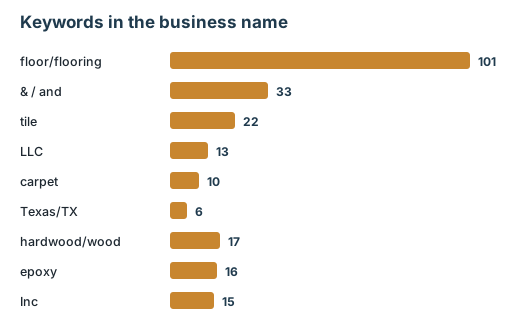
Across the 184 contractors, 101 (54.9 percent) include the word "floor" or "flooring" somewhere in their business name. That is a slim majority, and it is higher than many would guess going in: more than half of the Houston field is handing Google and a prospective customer a direct textual signal of what the business actually does, for free, in the one field they control completely. A name like "Vinyl Floors Houston" or "Texas Wood Flooring" is working in every result it appears in.
The flip side still matters. The other 83 of 184 contractors, just under half the field, operate under a name that gives no direct flooring signal at all, leaning on a surname, an abstract brand, or a parent construction company instead. For a category where the exact match keyword still carries weight in local discovery, that group is counting on category fields, reviews, and the description to make up the difference, fields that, as the rest of this study shows, most contractors are not filling out either. The good news for Houston is that the core keyword is no longer the bottleneck for the majority; the open question is what the names say after the word "floor."
Materials and modifiers
If most Houston names get the generic keyword in, do they also name the specific material they specialize in? Mostly not. Material words are thin on the ground, and the way they are distributed says a lot about which trades think of themselves as a distinct specialty and which simply call themselves "flooring."
- Tile is the most common material word, appearing in 22 names (12.0 percent). Tile contractors are clearly the group most willing to name their niche outright.
- Hardwood or wood shows up in 17 names (9.2 percent), putting wood specialists just behind tile and ahead of every other material.
- Epoxy is a genuine Houston standout at 16 names (8.7 percent), almost level with wood. Garage and concrete coating specialists here are noticeably willing to brand around the product, which fits the steady stream of garage floor jobs running through the local reviews.
- Carpet appears in just 10 names (5.4 percent), a small share even though carpet remains one of the most installed products in the metro.
- Stone, marble, or granite turns up in 8 names (4.3 percent) and concrete in 7 (3.8 percent), the long tail of harder surface specialists.
- Vinyl and laminate are the great absentees, with 1 name (0.5 percent) for vinyl and 0 names (0.0 percent) for laminate. This is the most counterintuitive finding in the entire naming dataset: vinyl and laminate are among the most heavily installed flooring products in Houston homes today, yet virtually no contractor builds the name around them.
The vinyl and laminate blind spot is worth sitting with. Demand for these products is everywhere, the search terms are real, and the competition for the name is effectively zero. A Houston contractor who specializes in luxury vinyl plank and says so in the business name would stand almost alone in a field of 184, where exactly one rival currently does. That is not a crowded street to compete on; it is an empty one.
Partnership and entity framing
When a Houston name is not naming what it installs, what is it putting in the name instead? Often, relationships and legal structure. The single most common non keyword element in the dataset is not a material at all.
- Partnership or family framing leads: 33 names (17.9 percent) contain an "&" or the word "and." Nearly one in five Houston flooring businesses signals a partnership, a family, or a pairing right in the name. That edges out tile and beats every other material word outright.
- Inc appears in 15 names (8.2 percent), the most common entity marker, and LLC follows close behind at 13 names (7.1 percent).
- Geographic anchoring is strikingly light: only 6 names (3.3 percent) carry "Texas" or "TX," despite location being one of the strongest relevance signals in local search.
- Modifier words are rare too: install appears in 9 names (4.9 percent), design in 5 (2.7 percent), and authority words like pro, expert, or master in just 5 (2.7 percent).
Step back and the priorities of the field come into focus. A Houston flooring contractor is roughly as likely to tell you they are a partnership (17.9 percent) as to name any single material, and far more likely to put "Inc" or "LLC" in the name (a combined 28 of 184) than to put "Texas" in it (6 of 184). The instinct across the field is to signal who we are and how we are organized, while leaving where we do it for the search engine to infer.
The local SEO opportunity
Put all of this together and the Houston naming data points to one of the clearest, cheapest competitive openings in the whole study. The business name is a field every contractor controls completely, costs nothing to optimize, and carries real weight in local discovery. The encouraging part is that 54.9 percent of the field already gets the core keyword in. The opening sits one layer down: only 22 names say tile, only 16 say epoxy, and almost no one specifies vinyl (1) or laminate (0), while just 6 anchor to Houston's own state. The crowd is competing on partnerships and entity suffixes; almost no one is competing on the standout material plus the place a homeowner would actually type.
The implication is not that every contractor should rush to rename the business, and it is certainly not that "& Sons" should be stripped out of a name customers already know and trust. It is that the name is a signal, and much of the Houston field is using it to say things that do not help a stranger find them. Where it fits, a name that carries the service, the standout material, and ideally the city does discovery work in every result it appears in. For a Houston specialist in vinyl or laminate in particular, that lane is not just open; it is empty.
Houston Versus the Texas Average
To understand whether a Houston flooring contractor is ahead or behind, you need a baseline. Ours is the full statewide sample of 2,065 Texas flooring contractor Google Business Profiles, and the Houston cut of 184 profiles sits inside it. Holding the same metrics side by side reveals a clear personality for the Houston metro: it is a more competitive, more optimized market on the things buyers see first, with one notable soft spot. Houston profiles rate a little higher, name themselves around the keyword far more aggressively, and fill in slightly more of their profile, yet they carry fewer photos and a slightly thinner median review count than the state at large.
- Average rating: Houston 4.64 versus Texas 4.58. Houston runs a touch higher, so a 4.6 that looks strong statewide is merely average for the metro.
- Median reviews: Houston 4 versus Texas 5 (mean: Houston 51.8 versus Texas 42.1). The typical Houston profile carries one fewer review at the midpoint, even though the average is pulled higher by the metro's heavy hitters.
- Keyword in the business name: Houston 101 of 184 (54.9%) versus Texas 871 of 2,065 (42.2%). Houston contractors are far more likely to put floor or flooring directly in the name, a roughly 13 point gap.
- Description filled in: Houston 9 of 184 (4.9%) versus Texas 70 of 2,065 (3.4%). Both numbers are low, but Houston edges ahead on completing the "from the business" blurb.
- Website present: Houston 144 of 184 (78.3%) versus Texas 1,544 of 2,065 (74.8%). Houston profiles are slightly more likely to link a website.
- Median photos: Houston 19 versus Texas 28. This is the one place Houston falls behind the state, and it is not close: the typical Houston profile shows about a third fewer photos.
The story those deltas tell is consistent. On the levers that signal relevance, Houston is the more aggressive market. A 54.9% keyword-in-name rate against the statewide 42.2% means more than half of the Houston field has baked the search term right into the business name, versus closer to four in ten across Texas. Pair that with a higher website rate (78.3% versus 74.8%) and a higher, if still small, description-fill rate (4.9% versus 3.4%), and the picture is of a metro where contractors have leaned harder into the obvious optimization moves. If you are competing in Houston, the keyword-name advantage your neighbors enjoy is already priced in, so it differentiates you far less here than it would in a quieter Texas market.
Where Houston gives ground is on proof. The median Houston profile carries 19 photos against the state's 28, and a median of 4 reviews against the state's 5. So while the metro looks polished on naming and links, the typical listing is actually thinner on the visual and social evidence a homeowner scrolls through before calling. That gap is the opening: in a field that has largely maxed out the easy naming move but undershoots on photos and reviews, the profile that pairs Houston-level keyword optimization with state-beating photo depth and review volume stands out on exactly the signals the competition is neglecting.
Conclusions: A Blueprint to Adapt
The Houston flooring market is not a finished race, it is an opening. Across the 184 profiles in this study, the gaps are wide and predictable: most contractors carry almost no reviews, almost none fill in the fields Google hands them for free, and the one thing Houston already does well, keyword-rich naming, is the easiest edge to surrender. What follows is not a checklist to copy line by line. It is a blueprint of principles to adapt to your own business and your own corner of the Houston market, framed around the questions worth asking before your next move.
A blueprint for Houston contractors
Treat your Google Business Profile as three separate levers, each with a different cost and a different payoff. Two of them are gaps your competitors have left wide open. The third is an advantage you already hold and should defend. Work them in order of leverage, not in order of effort.
Build review volume
This is the largest gap in the entire study. A full 74 of the 184 Houston profiles have zero reviews, and the median contractor sits at just 4 reviews. That means the typical Houston flooring profile is nearly invisible as social proof, and a meaningful share has no proof at all.
The implication is blunt: a steady habit of asking for reviews vaults you past most of the market. You are not chasing the few high-volume outliers, you are clearing a bar that more than a third of your competitors have not cleared at all.
Questions to ask yourself
- The ask: do you have a repeatable moment, the day a job finishes, when you request a review every single time? With the median at 4 reviews, even one request per job changes your standing fast.
- The zero problem: if you are one of the 74 with no reviews, your first review is worth more than your tenth. What is stopping the very next satisfied customer from leaving one?
- Recency: volume is the floor, not the ceiling. A trickle of recent reviews tells a homeowner the business is alive today, not five years ago.
How to use this
Treat each point as a direction to adapt, not a fixed rule. Start where the gap between your profile and the data above is widest.
Claim the free fields
Google gives every profile a set of fields at no cost, and Houston contractors are leaving them empty. Only 9 of 184 profiles, just 4.9%, use the business description at all. That is a field you control completely, with room to name your services, your neighborhoods, and what sets you apart, and almost no one is using it.
Websites tell a similar story with more nuance: 144 of 184, or 78.3%, link to a website, which means roughly one in five Houston flooring profiles still has no site attached at all. The description is the near-free win sitting untouched; the website is the deeper investment that a fifth of the market has skipped.
Questions to ask yourself
- The description: with only 4.9% of profiles using it, writing a clear, honest description is one of the cheapest ways to stand apart. Have you actually filled yours in, in your own words?
- The website link: if you are in the 21.7% without a site, even a single credible page beats an empty field. Where does a curious homeowner go after they find your profile?
- Consistency: do the name, services, and story in your description match what your site and reviews say? Conflicting signals undercut both.
Keep your naming edge
This is the lever Houston already pulls well, which is exactly why it is easy to lose. More than half of Houston flooring businesses, 101 of 184 or 54.9%, put floor or flooring right in the business name. That is a real head start: a homeowner scanning a list of results sees instantly what you do.
The principle here is defense, not offense. The advantage is collective, so the risk is that a rebrand or a clever-but-vague name throws it away for the sake of style. Clarity beats cleverness when a stranger is choosing between you and the profile below you.
Questions to ask yourself
- Plain over clever: does your name tell a first-time visitor what you do, or does it make them guess? At 54.9% keyword-in-name, the market norm is clarity, do not break ranks downward.
- Don't trade it away: if you are weighing a rebrand, what does dropping floor or flooring from the name actually buy you against the head start you would surrender?
A blueprint for Houston homeowners
You do not need to read every profile. You need to read for patterns, because the gaps in this market tell you what to look for.
- Weigh review volume and recency together. With 74 of 184 Houston profiles carrying zero reviews and the median at just 4, a contractor with a steady stream of recent reviews has already separated from most of the field.
- Read for the praise patterns, not single raves. When the same compliments repeat across many different reviews, that consistency is the signal. One glowing review can be luck; a pattern is a habit.
- Treat repeated no-shows, damage, or lateness as warnings. A single bad day happens, but when those same complaints surface again and again, you are seeing how the company behaves under pressure, not a one-off.
Put this report to work
For homeowners: browse flooring contractors in Houston to compare these reviews and ratings yourself, or see the full Texas directory and how it works.
For contractors: the gaps above are your opening in the Houston market. List your business in the directory, and if you need a stronger online presence, get a flooring website.
Frequently Asked Questions
How many flooring contractors are in Houston with a Google Business Profile?
This study analyzed 184 Houston flooring contractors with a Google Business Profile. Of those, 110 had at least one visible Google review, and 144 (about 78.3%) listed a website on their profile. The sample is limited to flooring contractors specifically, and the figures reflect what is publicly visible on each profile rather than Google's full internal records.
What is the average Houston flooring contractor rating on Google?
The average Google rating across rated Houston flooring profiles was 4.64 stars. That is a high bar, and it means a single one or two star review can pull a small contractor below the local average quickly. Because Google only publishes a profile level average, this study works from that overall star figure rather than from individual per review star ratings.
How many reviews does a typical Houston flooring contractor have?
The median Houston flooring contractor had just 4 reviews, and 74 of the 184 profiles had zero visible reviews at all. In other words, review counts are thin for most of the market, so even a modest, steady stream of reviews can lift a contractor well above the typical Houston profile. The median is far more honest here than an average, which a handful of high volume profiles would distort.
Do Houston flooring contractors put "flooring" in their business name?
Yes, more than half do. 101 of the 184 Houston profiles, about 54.9%, included floor or flooring in the business name. That keyword in the name can help a contractor match what searchers actually type, but it also means roughly half the market does not, which leaves a clear opening for the contractors who do not yet name their core service.
Do Houston flooring contractors fill out their Google Business Profile description?
Almost none do. Only 9 of the 184 Houston profiles, about 4.9%, had a filled in business description, even though 144 (roughly 78.3%) had already added a website. The description field is free, it is one of the few spots a contractor controls in their own words, and leaving it blank is one of the most common and most fixable gaps in the Houston market.
What do Houston flooring customers complain about and praise most?
Across 674 visible Houston reviews, the single most common complaint word was "never", appearing 21 times and almost always tied to a no show, a missed callback, or a promise that was never kept. Praise was far louder than criticism: "great" appeared 230 times, "professional" 211 times, and "recommend" 210 times. The pattern is clear: Houston complaints are mostly about reliability and showing up, while happy customers reward professionalism and then tell other people to hire the contractor.
How does Houston compare to Texas overall?
Houston tracks the statewide pattern closely. The Houston average rating of 4.64 stars sits in the same high range as the broader Texas flooring market, and the same complaint signal leads in both: the word "never", at 21 mentions in Houston, points to reliability problems just as it does statewide. The same praise words, great, professional, and recommend, dominate in both data sets, so a contractor who shows up on time and finishes clean is rewarded the same way in Houston as anywhere else in Texas.
Related Reports
Keep exploring the Texas flooring data network:
The statewide study
Topic deep dives
- What Texas Flooring Customers Complain About (and Praise): A Review Study
- Ratings and Review Volume Across Texas Flooring Contractors
- How Texas Flooring Contractors Name Their Businesses
- Services, Categories, and Profile Completeness of Texas Flooring Contractors